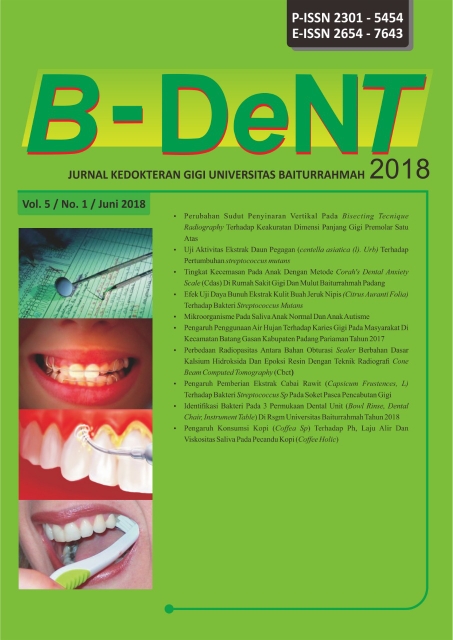
EFEK UJI DAYA BUNUH EKSTRAK KULIT BUAH JERUK NIPIS (CITRUS AURANTI FOLIA) TERHADAP BAKTERI STREPTOCOCCUS MUTANS
DOI:
https://doi.org/10.33854/JBDjbd.135Keywords:
Lemon Peel Extract (Citrus aurantifolia), Concentration 12, 5%, 25%, 50% and 100%, Streptococcus mutans bacteriaAbstract
One effort to reduce the number of dental caries in the community is needed antibacterial that can kill the bacteria Streptococcus mutans. One of the antibacterials of nature that can be used as a drug is lime (Citrus aurantifolia). The purpose of this research was to determine the effect of kill power test extract of lime peel (Citrus aurantifolia) against Streptococcus mutans bacteria, the type of research used is laboratory experimental. The samples were colonies of Streptococcus mutans bacteria obtained from University of Indonesia, with 6 treatments in each extract 12.5%, 25%, 50% and 100%. This study used 4 concentrations (12.5%, 25%, 50% and 100% as well as negative and positive control) using Kruskall-Wallis test. The results showed that there was inhibitory power and kill power extract of citrus fruits (Citrus aurantifolia) against Streptococcus mutans bacteria with a value of 0.000 <0,05. 50% concentration is the most effective concentration for bacterial inhibition and 100% concentration is the most effective concentration for killing strength of Streptococcus mutans bacteriaReferences
Afiati, R, Rosihan, A, Karina, R, Sherli, D 2017, ‘Hubungan Prilaku Ibu Tentang pemeliharaan Kesehatan Gigi dan Mulut Terhadap Status Karies Gigi Anak’, Dentino (Jur. Ked. Gigi), Vol. II, no. 1.
Ladytama. S, Ariana.N, Moh. B, 2014 ‘Efektifitas larutan ekstrak jeruk nipis (Citrus Aurantifaia) sebagai obat kumur terhadap penurunan indeks plak pada remaja usia 12-15 tahun-Studi di SMP Nurul Islami, Mijen, Semarang
Widayati, N 2014,’Faktor yang Berhubungan dengan Karies Gigi pada Anak Usia 4-6 Tahun’, Jurnal Berkala Epidemiologi, vol. 2, no. 2.
Pratiwi, R 2005, ‘Perbedaan Daya Hambat Terhadap Streptococcus mutans dari Beberapa Pasta Gigi yang Mengndung Herbal’, Maj.Ked.Gigi. (Dent. J.), vol. 38, no. 2.
Fatmawati, DWA 2011, ‘Hubungan Biofilm Streptococcus mutans Terhadap ResikoTerjadinya Karies Gigi’, Stomatognatic (J.K.G Unej), vol. 8, no. 3.
Pradani, NR 2012, Uji Aktivitas Antibakteri Air Perasan Jeruk Nipis (Citrus aurantifolia) Terhadap Pertumbuhan Bakteri Staphylococcus aureus Secara In Vitro, Karya Tulis Ilmiah Strata 1, Universitas Jember.
Adindaputri, ZA, Nunuk, P & Ivan AW 2013, ’Pengaruh Ektrak Kulit Jeruk Nipis (Citrus aurantifolia Swigle) Konsentrasi 10% Terhadap Aktivitas Enzim Glukosiltransferase Streptococcus mutans’, Maj Ked Gi, p. 127.
Aldi, ATUDA 2016, Efektifitas Ektrak Kulit Jeruk Nipis (Citrus aurantifolia) dengan NaOCl 5,25% Sebagai Alternatif Larutan Irigasi Saluran Akar Dalam Menghambat Bakteri Enterococcus faecalis, Karya Tulis Ilmiah Strata 1, Universitas Hasanuddin, Makasar, p. 3.
Gabrina, G 2014, Efektifitas Ektrak Kulit Jeruk Nipis (Citrus aurantifolia (Chrism.) Swigle) Terhadap Bakteri Porphyromonas gingivalis Secara In Vitro, Karya Tulis Ilmiah Strata 1, Universitas Sumatra Utara, Medan.
Enda, F, 2012, Pengaruh Pemberian Larutan Ekstrak Jeruk Nipis (Citrus aurantifolia) Terhadap Pembentukan Plak Gigi, Karya Tulis Ilmiah Strata 1, Universitas Diponegoro.
Sari, LORK 2006, ‘Pemanfaatan Obat Tradisional dengan Pertimbangan Manfaat dan Keamanannya’, Majalah Ilmu Kefarmasian, vol. III, no. 1.
Jayani, NIE, Kartini, & Nurul M 2017 ‘Formulasi sediaan Sabun Cuci Ekstrak Jeruk Nipis (Citrus aurantifolia) dan Efektifitasnya sebagai Antiseptik’, Artikel Penelitian, Media Pharmaceutica Indonesia, vol.1, no.4.
Setiawati, A, 2015, ‘Peningkatan Resistensi Kultur Bakteri Staphylococcus aureus terhadap Amoxcicilin Menggunakan Metode Adaptif Grandual’, Jurnal Farmasi Indonesia, vol.7, no.3.
Downloads
Published
Issue
Section
License
Copyright (c) 2019 Miftha Ulya, Fauzia Nilam Orienty, Maulida Hayati

This work is licensed under a Creative Commons Attribution-NonCommercial-ShareAlike 4.0 International License.
Authors who publish with this journal agree to the following terms: Authors retain copyright and grant the journal right of first publication with the work simultaneously licensed under a Creative Commons Attribution License (CC BY-NC-SA 4.0) that allows others to share the work with an acknowledgement of the work's authorship and initial publication in this journal.