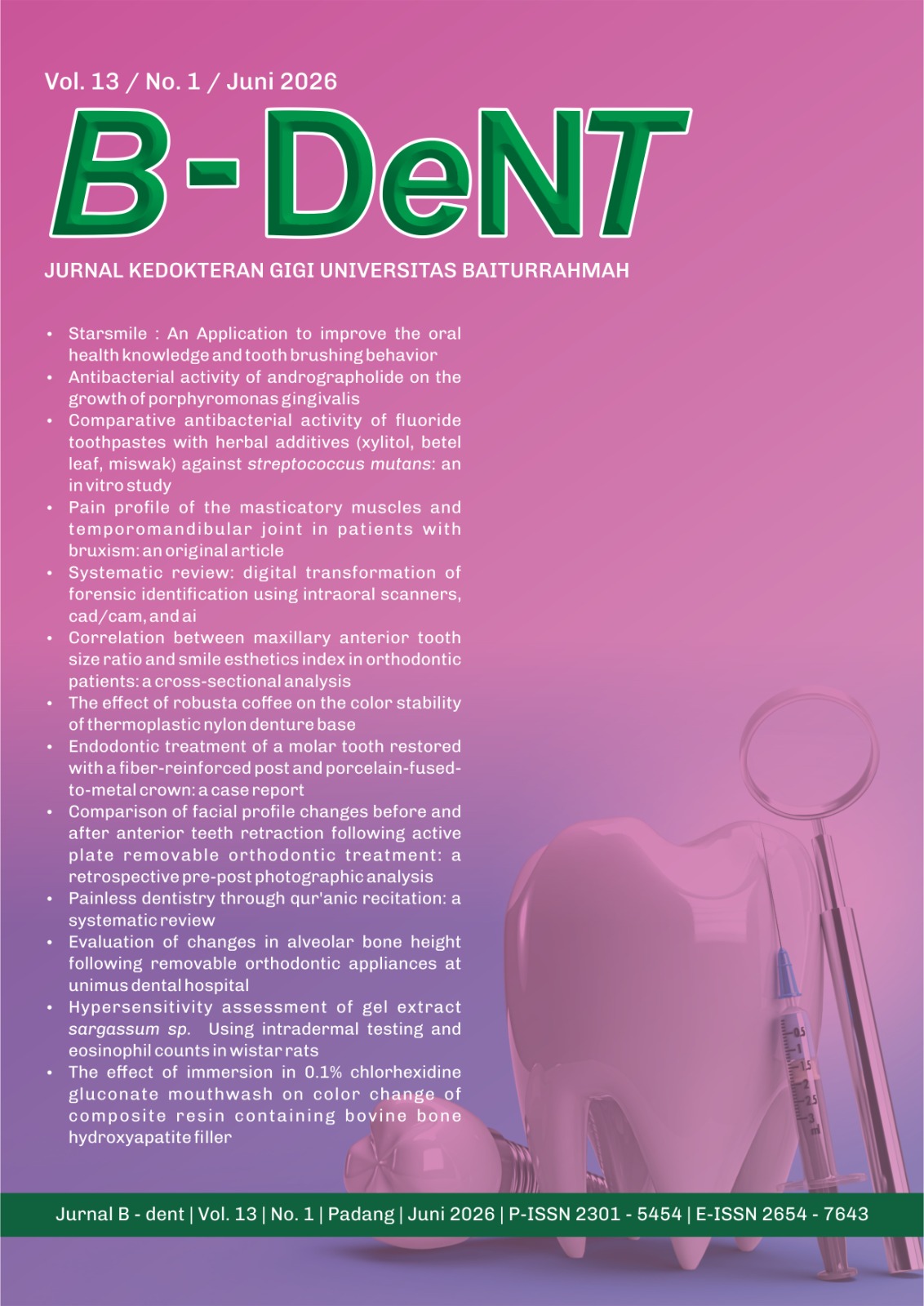
Profil Nyeri pada Otot Pengunyahan dan Sendi Temporomandibular pada Pasien dengan Bruxism: Artikel Orisinal
Abstrak
AbstrakTujuan: Menentukan profil nyeri pada otot mastikasi dan sendi temporomandibular (TMJ) pada penderita bruksisme berdasarkan lokasi dan jenis nyerinya.Bahan dan Metode: Penelitian ini merupakan studi retrospektif yang menggunakan data sekunder dari rekam medis 30 pasien bruksisme yang dirawat di Klinik Prostodonsia Rumah Sakit Gigi dan Mulut Universitas Padjadjaran antara tahun 2023 hingga 2025. Kriteria inklusi meliputi pasien dengan diagnosis bruksisme yang lengkap. Kriteria eksklusi meliputi rekam medis tanpa pemeriksaan Diagnostic Criteria for Temporomandibular Disorders (DC/TMD). Data dianalisis menggunakan analisis deskriptif kuantitatif untuk mengidentifikasi lokasi dan karakteristik nyeri otot.Hasil: Data dari 30 rekam medis yang memenuhi kriteria inklusi dan eksklusi menunjukkan bahwa nyeri otot mastikasi paling sering terjadi pada otot masseter (70%), temporalis (56,67%), pterigoid lateral (46,67%), pterigoid medial (3,33%), dan otot lainnya (13,33%). Nyeri pada sendi temporomandibular (TMJ) juga ditemukan (63,33%). Jenis nyeri otot terdiri dari mialgia lokal (63,33%), nyeri otot miofasial (20%), dan tidak ada nyeri (16,67%).Kesimpulan: Lokasi nyeri otot mastikasi yang paling umum pada penderita bruksisme adalah pada otot masseter serta juga ditemukan pada TMJ, dengan jenis nyeri otot yang paling umum adalah mialgia lokal.Referensi
REFERENCES
Att W, Freilich MA, Ferro KJ, Kelly JA, Muller F,
Nguyen CT, et al. The glossary of prosthodontic
terms 2023: 10th Edition. J Prosthet Dent.
;130(4):1–126.
Bulanda S, Ilczuk-Rypuła D, Nitecka-Buchta A,
Nowak Z, Baron S, Postek-Stefańska L. Sleep
bruxism in children: Etiology, diagnosis and
treatment—a literature review. Int J Environ Res
Public Health. 2021;18(18):1–9.
Zieliński G, Pająk A, Wójcicki M. Global
prevalence of sleep bruxism and awake bruxism in
pediatric and adult populations: a systematic
review and meta-analysis. J Clin Med.
;13(14):4259–89.
Kholid IT, Elih E, Sasmita IS, Hasyimi AA.
Prevalensi kebiasaan buruk bruksisme pada anak
dengan gangguan spektrum autisme: studi cross
sectional. Padjadjaran J Dent Res Stud.
;7(2):119–22.
Gizler M, Pietrzak N, Saczuk K, LukomskaSzymanska M, Lapinska B. Students’ awareness of
the bruxism causes, effects and therapies. Heliyon.
;10(1):1–14.
Okeson JP. Management of Temporomandibular
Disorders and Occlusion. Vol. 7. Elsevier; 2019.
–5 p.
Schiffman E, Ohrbach R, Truelove E, Look J,
Anderson G, Goulet JP, et al. Diagnostic criteria
for temporomandibular disorders (DC/TMD) for
clinical and research applications:
recommendations of the International RDC/TMD
consortium network and orofacial pain special
interest group†. J Oral Facial Pain Headache.
;28(1):6–27.
Barjandi G, Svedenlöf J, Jasim H, Collin M,
Hedenberg-Magnusson B, Christidis N, et al.
Clinical aspects of mastication myalgia—An
overview. Front Pain Res. 2024;4:1–12.
Friedman Rubin P, Erez A, Peretz B, BirenboimWilensky R, Winocur E. Prevalence of bruxism
and temporomandibular disorders among orphans
in southeast Uganda: A gender and age
comparison. J Craniomandib Sleep Pract.
;36(4):243–9.
Rahmad Y, Edrizal E, Berhana ATO. The
relationship between stress and
temporomandibular disorder in students of the
Faculty of Dentistry, Baiturrahmah University
Class of 2020. Odonto Dent J. 2024;11(1):105–14.
American Psychological Association. Stress in
America: The state of our nation. Stress Am Surv.
;1–9.
Lee YH, Chun YH, Bae H, Lee JW, Kim HJ.
Comparison of ultrasonography-based masticatory
muscle thickness between temporomandibular
disorders bruxers and temporomandibular
disorders non-bruxers. Sci Rep. 2024;14(1):6923.
Koruyucu AN, Aşantoğrol F. Determination of
masseter and temporal muscle thickness by
ultrasound and muscle hardness by shear wave
elastography in healthy adults as reference values.
Dentomaxillofacial Radiol. 2023;53(2):137–52.
Garip H, Tufekcioglu S, Kaya E. Changes in the
temporomandibular joint disc and temporal and
masseter muscles secondary to bruxism in Turkish
patients. Saudi Med J. 2018;39(1):81–5.
Packiasabapathy S, Sadhasivam S. Gender,
genetics, and analgesia: understanding the
differences in response to pain relief. J Pain Res.
;11:2729–39.
Uchima Koecklin KH, Aliaga-Del Castillo A, Li P.
The neural substrates of bruxism: current
knowledge and clinical implications. Front Neurol.
;15:1–11.
Lobbezoo F, Ahlberg J, Raphael KG, Wetselaar P,
Glaros AG, Kato T, et al. International consensus
on the assessment of bruxism: Report of a work in
progress. J Oral Rehabil. 2018;45(11):837–44.
Scheibel J, Schwahn C, Mksoud M, Mundt T,
Bernhardt O, Kiliaridis S, et al. Influence of gender
and bruxism on the masseter muscle: A populationbased magnetic resonance imaging study. Am J
Orthod Dentofacial Orthop. 2025;167(1):80–8.
Meidarlina I, Rikmasari R. Stabilization splint and
its role in overcoming temporomandibular joint
disorders. MakassarDental Journal.
;12(3):323–7.
Ginting R, Napitupulu FMN. Gejala klinis dan
faktor penyebab kelainan temporomandibular joint
pada kelas I oklusi angle. J Kedokt Gigi Univ
Padjadjaran [Internet]. 2019 Aug 31 [cited 2025
Jul 18];31(2). Available from:
http://jurnal.unpad.ac.id/jkg/article/view/21440
Noguchi T, Kashiwagi K, Fukuda K. The
effectiveness of stabilization appliance therapy
among patients with myalgia. Clin Exp Dent Res.
;6(2):244–53.
Winocur-Arias O, Friedman-Rubin P, Abu Ras K,
Lockerman L, Emodi-Perlman A, Greenbaum T, et
al. Local myalgia compared to myofascial pain
with referral according to the DC/TMD: Axis I and
II results. BMC Oral Health. 2022;22(1):27.
Dawson PE. Functional Occlusion: From TMJ to
Smile Design. St. Louis (MO): Mosby Elsevier;
Poluha RL, Canales GT, Bonjardim LR, Conti
PCR. Oral behaviors, bruxism, malocclusion and
painful temporomandibular joint clicking: is there
an association? Braz Oral Res. 2021;35:e090.
doi:10.1590/1807-3107bor-2021.vol35.0090.
Unduhan
Diterbitkan
Terbitan
Bagian
Lisensi
Hak Cipta (c) 2026 Ista Meidarlina, Rasmi Rikmasari, Sana Giovani Pramudita

Artikel ini berlisensiCreative Commons Attribution-NonCommercial-ShareAlike 4.0 International License.
Authors who publish with this journal agree to the following terms: Authors retain copyright and grant the journal right of first publication with the work simultaneously licensed under a Creative Commons Attribution License (CC BY-NC-SA 4.0) that allows others to share the work with an acknowledgement of the work's authorship and initial publication in this journal.