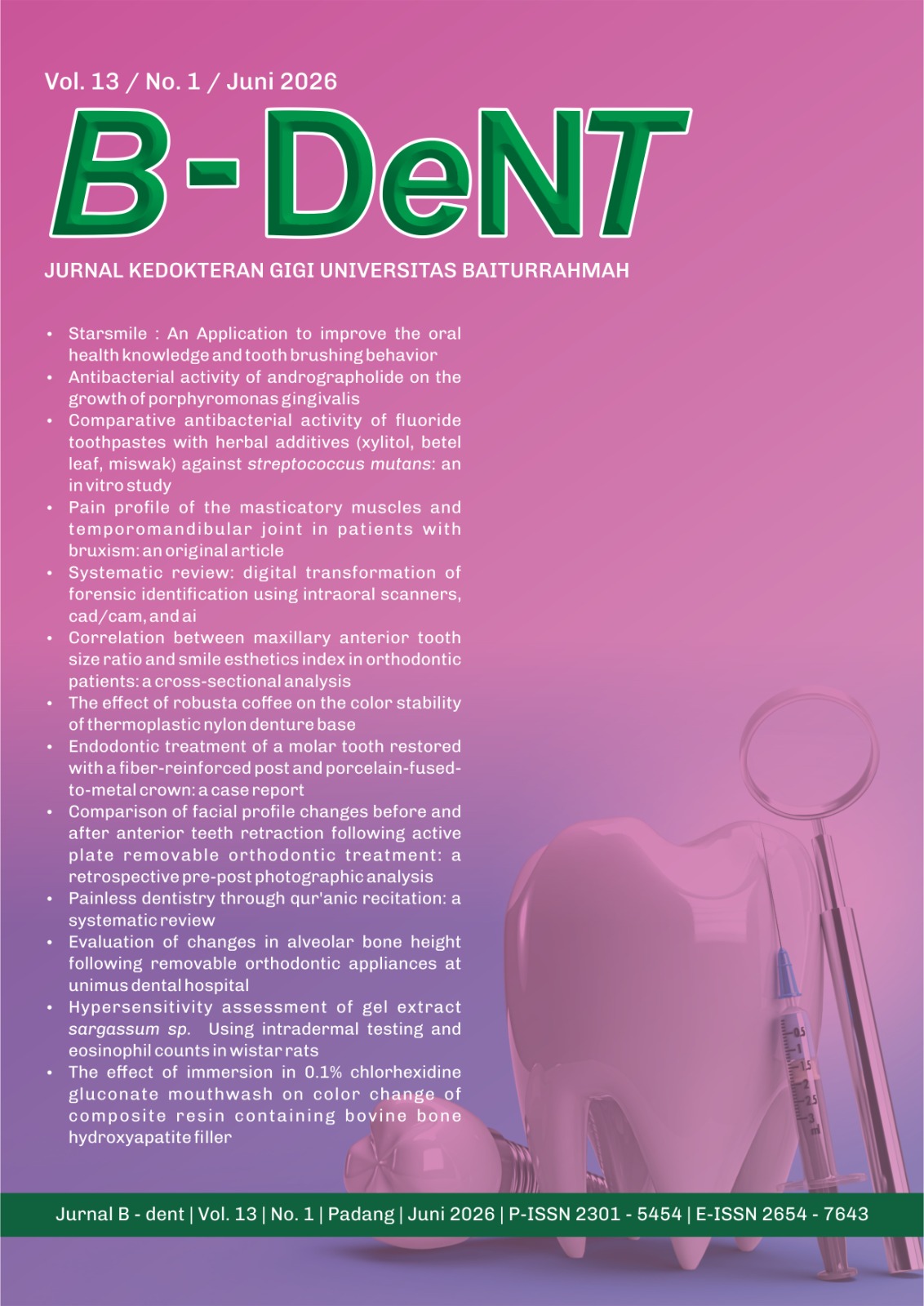
PENDEKATAN PAINLESS DENTISTRY DENGAN MENDENGARKAN MUROTTAL AL-QUR’AN: SUATU KAJIAN SISTEMATIK
DOI:
https://doi.org/10.33854/jbd.v13i1.2090Kata Kunci:
Anxiety, dentistry, painless dentistry, Quranic recitation, spiritual therapyAbstrak
Introduction: Dental anxiety significantly affects patient comfort and clinical outcomes. Painless dentistry aims to provide safe, anxiety-free dental experiences. Qur’anic recitation, which is a recording of the holy verses of the Al-Qur'an read by a qari (Qur'an reader) with a slow, tartil and harmonious tempo, in accordance with the correct rules of tajwid, is believed to have a calming effect on the patient's psychology and physiology. Aim: This systematic review examines the effectiveness of Qur’anic recitation in reducing dental anxiety and explores its psychological, physiological, and patient satisfaction outcomes. Methods: A systematic search (2011–2025) of PubMed, Scopus, Google Scholar, and Garuda was conducted using the keywords “Qur’an recitation”, “dental anxiety”, “painless dentistry”, and “spiritual intervention”. Of 161 identified studies, 50 met the inclusion criteria and were analyzed for anxiety reduction, physiological effects, and patient satisfaction. Results: Most studies showed significant anxiety reduction following Qur’anic recitation, often accompanied by decreased heart rate and blood pressure. The intervention performed comparably or better than music and other relaxation therapies. Patient satisfaction improved due to its spiritual and cultural relevance. Limitations included small sample sizes and heterogeneous methodologies. Conclusion: Qur’anic recitation is a promising, non-pharmacological adjunct for anxiety management in painless dentistry. Further large-scale randomized trials with standardized protocols are required to validate its effectiveness and clinical integration.Referensi
REFERENCES
Yanti TT, Shanti RRD. The effect of Al-Qur'an murottal therapy on changes in preoperative patients' anxiety levels at RSUD Kota Bogor. J Ilm Wijaya. 2020;11(2). doi:10.46508/JIW.V11I2.55.
Alattar AN, Hamzah BF. Psychotherapeutic effect of listening to Quran recitation on dental anxiety: A randomized controlled trial. Dent Hypotheses. 2024;15(4):59-62. doi:10.4103/denthyp.denthyp_124_23.
Ajorpaz NM, Aghajani M, Shahshahani MS. The effects of music and Holy Quran on patients' anxiety and vital signs before abdominal surgery. Evidence Based Care. 2011;1(1):63-76. doi:10.22038/EBCJ.2011.3765.
Yunus ES, Arismunandar PA, Rukanta D. Scoping review: Pengaruh mendengarkan murottal Al-Qur'an terhadap tingkat stres orang dewasa. J Integr Kesehat Sains. 2021;3:110-116.
Azhar SA, Praptiningsih RS, Agustin ED. Pengaruh mendengarkan ayat suci Al-Qur'an terhadap tingkat kecemasan pasien sebelum tindakan ekstraksi gigi. Odonto Dent J. 2016. doi:10.30659/ODJ.3.1.55-59.
Hojjati A, Musavi V, Usefi AA, Shahsiah M, Botlani S. The comparison between Quran sound and quiet music on anxiety decrease of patients waiting for dental surgery in 2010. In: Proceedings of the First International and Fourth National Congress on Health Education and Promotion; 2011.
Apriyono DK. The effect of classic music therapy and the Qur'an murottal on patient anxiety levels before tooth extraction. J Multidisiplin Madani. 2023;3(5):1053-1065. doi:10.55927/mudima.v3i5.3509.
Irfan NU, Atique H, Taufiq A, Irfan A. Differences in brain waves and blood pressure by listening to Quran-e-Kareem and music. J Islamabad Med Dent Coll. 2019;8(1). doi:10.35787/JIMDC.V8I1.315.
Majidi H, Rajabi-Tavakkol A. A systematic review of EEG studies on the neural effects of Quran listening. Iran J Psychiatry. 2025;20(2):253-264. doi:10.18502/ijps.v20i2.18206.
Che Wan Mohd Rozali WNA, Ishak I, Mat Ludin AF, Ibrahim FW, Abd Warif NM, Che Roos NA. The impact of listening to, reciting, or memorizing the Quran on physical and mental health of Muslims: Evidence from a systematic review. Int J Public Health. 2022;67:1604998. doi:10.3389/ijph.2022.1604998.
Faheim SS, Mahfouz FFA, Hegazy A, Mahmoud H. Effect of selected auditory interventions on reducing chemotherapy-induced anxiety and pain of children with cancer and their parents' satisfaction. Tanta Sci Nurs J. 2022;27(44):211-230. doi:10.21608/TSNJ.2022.274257.
Wahyuningsih IS, Sukartini T, Dewi YS, Amal AI, Kismana ML. The effect of murottal auditory therapy on anxiety and comfort levels in patients with cardiovascular disease. Healthc Low Resour Settings. 2023. doi:10.4081/hls.2023.11816.
Zulkifli NA, Zain UIZM, Hadi AA, Ismail MN, Aziz KHA. Effects of listening to Quran recitation and nature sounds on preoperative anxiety among patients undergoing surgery. Pak J Psychol Res. 2022;37(2):295-310. doi:10.33824/PJPR.2022.37.2.18.
Wisuda AC, Sansuwito T, Suraya C, Rusmarita R, Emiliasari D. Enhancing mental well-being in coronary heart disease patients: The impact of integrated spiritual care and murottal auditory therapy on reducing anxiety and depression. Healthc Low Resour Settings. 2024. doi:10.4081/hls.2024.12621.
Asrul A. The qualitative analysis of Qur'an murottal on surgical anxiety reduction. Med Spirit Res J. 2023;7(1):13-19.
Asrul A. Effectiveness of Al-Qur'an murottal therapy against anxiety of preoperative patients. Sandi Husada J Ilm Kesehat. 2023;12(1):129-135. doi:10.35816/jiskh.v12i1.913.
Gavgani VZ, Ghojazadeh M, Sadeghi-Ghyassi F, Khodapanah T. Effects of listening to Quran recitation on anxiety reduction in elective surgeries: A systematic review and meta-analysis. Arch Psychol Relig. 2022;44(2):111-126. doi:10.1177/00846724221102198.
Erlena EWL, Suryani RL, Yudha MB. Implementation of murottal therapy to reduce preoperative anxiety in patients with spinal anesthesia. Java Nurs J. 2024;2(3):266-273. doi:10.61716/jnj.v2i3.60.
Maharani HS, Mustofa A. Terapi murattal Al-Qur'an Surah Ar-Rahman dalam menurunkan kecemasan pada pasien kritis di ruang ICU. Ners Muda. 2024;5(2):162-169. doi:10.26714/nm.v5i2.13139.
Erpina D, Mochartini T. Efektivitas pemberian aromaterapi lavender, relaksasi Benson, dan mendengarkan murottal Al-Qur'an terhadap tingkat kecemasan pre anestesi dengan tindakan spinal anestesi di RS Pelabuhan Jakarta. Mahesa. 2024. doi:10.33024/mahesa.v4i8.14228.
Rusdi A, Nurtjahjo FE, Sakinah S. Difference in effects of listening to the Al-Quran and music on sensibility. J Psikol Islam Budaya. 2024;7(1):47-56. doi:10.15575/jpib.v7i1.31761.
AbuRuz ME, Al-Dweik G, Ahmed F. The effect of listening to Holy Quran recital on pain and length of stay post-CABG: A randomized control trial. Crit Care Res Pract. 2023;2023:9430510. doi:10.1155/2023/9430510.
Rohadi DAK, Maliya A. Pengaruh terapi murottal Al-Qur'an terhadap tingkat kecemasan pasien pre dan post operasi: Study case. J Kesehat Tambusai. 2025;6(2):5484-5491. doi:10.31004/jkt.v6i2.43839.
Hastuti I, Alamsyah AZ, Hamzah A, Alamsah MS. Pengaruh terapi murottal Surat Ar-Rahman terhadap kecemasan pasien. J Ilmu Kesehat Bhakti Husada. 2025;16(1):234-241. doi:10.34305/jikbh.v16i01.1649.
Suzana M, Mayenti F, Yenita RN, Tanberika FS. Implementation therapy murottal Al-Qur'an against reduction of anxiety levels in patients pre-caesarean section. Corona. 2025;3(2):193-201. doi:10.61132/corona.v3i2.1261.
Lastaro B, Apriliyani I, Susanti I. Pengaruh terapi murottal Al-Qur'an terhadap tingkat kecemasan pasien pre operasi sectio caesarea. J Penelit Perawat Prof. 2023;6(2). doi:10.37287/jppp.v6i2.2178.
Islamiaty A, Suhermi S, Agus AI. Terapi murottal terhadap penurunan kecemasan pasien pre sectio caesarea. Window Nurs J. 2023;4(2):192-201. doi:10.33096/won.v4i2.628.
Iryani E, Ismansyah, Firdaus R. The effect of Al-Quran murottal therapy on pain and anxiety scores in preoperative patients in inpatient rooms. Formosa J Sci Technol. 2023;2(5):1263-1284. doi:10.55927/fjst.v2i5.4029.
Syamdarniati S. Pengaruh terapi murottal Al-Qur'an Surat Al-Fatihah, Al-Ikhlas, Al-Falaq, dan An-Nas terhadap tingkat kecemasan pasien pre-operasi. J Penelit Perawat Prof. 2023;5(2):849-854. doi:10.37287/jppp.v5i2.1612.
Penerapan terapi murottal Al-Qur'an dan relaksasi nafas dalam terhadap penurunan tingkat kecemasan klien pre operasi fraktur femur dengan tindakan ORIF di Rumah Sakit Islam Purwokerto. J Cakrawala Ilm. 2023. doi:10.53625/jcijurnalcakrawalailmiah.v2i11.611.
Gunawan H, Mariyam M. Murottal Qur'an Surah Ar-Rahman menurunkan tingkat kecemasan pasien pre-operasi katarak. Ners Muda. 2022;3(2). doi:10.26714/nm.v3i2.8974.
Kaslinda KNU. Efektifitas nafas Qur'an terhadap tingkat kecemasan pada pasien pre operasi. J Ilm Keperawatan. 2024;12(1). doi:10.52236/ih.v12i1.377.
Faridah VN. Terapi murottal (Al-Qur'an) mampu menurunkan tingkat kecemasan pada pasien pre operasi laparatomi. J Keperawatan. 2015;6(1). doi:10.22219/JK.V6I1.2854.
Herlina SM, Ulya Y, Yunika RP. Efektivitas terapi murottal Al-Qur'an terhadap tingkat kecemasan ibu bersalin. J Fundus. 2023;3(2):1-7. doi:10.57267/fundus.v4i1.354.
Saputro TD, Wahyuningtyas ES, Kamal S. An experimental study on the impact of Holy Qur'an recitation in reducing anxiety among preoperative patients in Indonesia. Innov Health Soc. 2024;5(1). doi:10.31603/ihs.12506.
Purnomo DA, Sari DJE, Widiyawati W, Widiharti W. The effect of audio distraction technique hearing the murrotal Al-Qur'an on anxiety in pre-operative patients at Muhammadiyah Gresik Hospital. Kontribusia. 2024;7(2). doi:10.30587/kontribusia.v7i2.8047.
Wisuda AC, Sansuwito T, Suraya C, Rusmarita R, Emiliasari D. Enhancing mental well-being in coronary heart disease patients: The impact of integrated spiritual care and murottal auditory therapy on reducing anxiety and depression. Healthc Low Resour Settings. 2024. doi:10.4081/hls.2024.12621.
Mohamed S, Mohamed M, Ahmed SM, Ali HA. Effect of listening to Holy Qur'an verses on labor progress, maternal and neonatal outcomes. Port Said Sci J Nurs. 2022;9(2):73-95. doi:10.21608/pssjn.2022.92173.1140.
Hudiyawati D, Aji PT, Jumaiyah W, Syafriati A, Tyawarman A. Pengaruh terapi murottal Al-Qur'an terhadap kecemasan pasien dengan prosedur percutaneous coronary intervention. J Berita Ilmu Keperawatan. 2022;15(1). doi:10.23917/bik.v15i1.17049.
Taha R, Firmawati F, Harismayanti H. Efektivitas terapi spiritual murottal Al-Qur'an dan terapi dzikir terhadap penurunan tingkat kecemasan pasien hemodialisa di RSUD Toto Kabila. J Ilm Keperawatan Gorontalo. 2023;1(2). doi:10.55606/jikg.v1i2.978.
Al-Jubouri MB, Isam SR, Hussein SM, Machuca-Contreras F. Recitation of Quran and music to reduce chemotherapy-induced anxiety among adult patients with cancer: A clinical trial. Nurs Open. 2021. doi:10.1002/nop2.781.
Rustam JS, Kongsuwan W, Kitrungrote L. Effect of comfort care integrated with the Holy Qur'an recitation on comfort of Muslim patients under mechanical ventilation: A pilot study. Med Surg Nurs J. 2017;6(1):34-40.
Amelia AR, Ahri RA, Jiranah J. Pengaruh stimulus auditori Qur'an atau murottal Qur'an terhadap penurunan ansietas pada penderita hipertensi. J Keperawatan Jiwa. 2022;10(1):45-56. doi:10.26714/jkj.10.1.2022.45-56.
Nasiri M, Naboureh A, Fayazi S. The effect of an Islamic praise (zikr) on postoperative anxiety of patients undergoing coronary artery bypass graft surgery: A randomized clinical trial on Iranian Shia Muslims. Res Cardiovasc Med. 2016;6(3). doi:10.5812/cardiovascmed.41388.
Hosseini M, Salehi A, Khoshknab MF, Rokofian A, Davidson PM. The effect of a preoperative spiritual/religious intervention on anxiety in Shia Muslim patients undergoing coronary artery bypass graft surgery: A randomized controlled trial. J Holist Nurs. 2013;31(3):164-172. doi:10.1177/0898010113488242.
A S, N Y, Wr WM, A M, Cy L, A I. Listening to Islamic praises (Dzikr) is more effective in reducing perioperative anxiety levels when compared to nature-based sounds in Muslim patients undergoing surgery under regional anaesthesia. IIUM Med J Malays. 2020. doi:10.31436/IMJM.V18I3.191.
Ardinansyah A, Nosi NH, Atmaji M, Hatta R, Attamimi FA. Edukasi painless dentistry dan penanganan awal kedaruratan dental pada guru SDN 03 Cempaka Putih Barat. J Pengabd Masy Bangsa. 2024;2(9):3957-3963. doi:10.59837/jpmba.v2i9.1598.
Ardinansyah A, Prastiyani NH, Hatta R, Attamimi FA, Surachmin A. Buku saku painless dentistry untuk umum. 1st ed. Jakarta: Penerbit Universitas YARSI; 2024. ISBN: 978-979-9186-49-2.
Unduhan
Diterbitkan
Terbitan
Bagian
Lisensi
Hak Cipta (c) 2026 Nur Hidayati Nosi Prastiyani, Agus Ardinansyah, Fatimah Azzahra Attamimi, Chaerita Maulani

Artikel ini berlisensiCreative Commons Attribution-NonCommercial-ShareAlike 4.0 International License.
Authors who publish with this journal agree to the following terms: Authors retain copyright and grant the journal right of first publication with the work simultaneously licensed under a Creative Commons Attribution License (CC BY-NC-SA 4.0) that allows others to share the work with an acknowledgement of the work's authorship and initial publication in this journal.