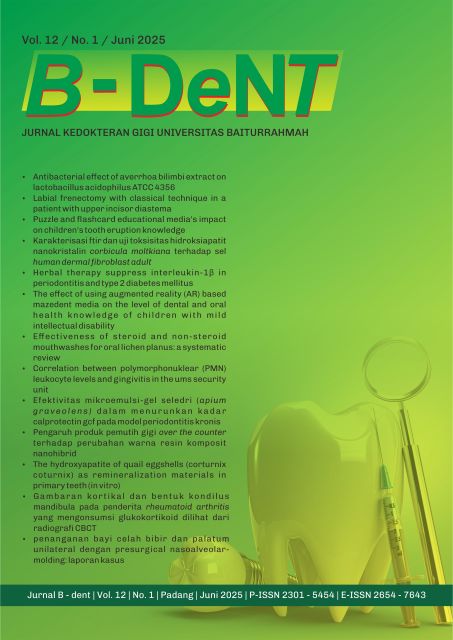
KARAKTERISASI FTIR DAN UJI TOKSISITAS HIDROKSIAPATIT NANOKRISTALIN Corbicula moltkiana TERHADAP SEL HUMAN DERMAL FIBROBLAS ADULT
DOI:
https://doi.org/10.33854/jbd.v12i1.1814Kata Kunci:
FTIR Characterization, Cell Viability, nHA Corbicula Moltkiana, Toxicity, HDFa CellsAbstrak
Background: One way to reconstruct bones is with bone grafting. Hydroxyapatite (HA) is often used as a bone graft, because it has biocompatibility, osteoconductive, bioactive, non-toxic and non-immunogenic properties. HA can be obtained from natural materials such as shells, limestone, egg shells and others. Using natural materials has several advantages such as high Ca/P ratio content, abundant quantities, and cheaper material production costs. The nanocrystalline hydroxyapatite (nHA) used in this research is Corbicula moltkiana shell powder. Purpose: to know; a) FTIR characterization of nHA Corbicula moltkiana; b) the level of toxicity of Corbicula moltkiana nHA on HDFA cells, and c) the ideal concentration of Corbicula moltkiana nHA on HDFA cell viability. Methods: in vitro laboratory experiment with post-test only control group design. To find out the characterization, use the FTIR characterization test. Toxicity test using the MTT method. The research samples were Corbicula moltkiana nHA powder and HDFA cells. The samples were divided into 4 groups, namely the control cell group and 3 groups of nHA Corbicula moltkiana with concentrations of 25 µg/ml, 50 µg/ml, and 100 µg/ml. Results: 1) Corbicula moltkiana nHA powder has good HA quality, 2) cell viability at concentrations of 25 µg/ml, 50 µg/ml, and 100 µg/ml against HDFA cells was 99.64%, 96.51% and 83.93%, respectively. Conclusions: 1) the higher the concentration of Corbicula moltkiana nHA, the lower the viability of HDFA cells, but all concentrations studied were not toxic, 2) Corbicula moltkiana nHA is biocompatible with HDFA cells.Referensi
Dala, Y. N. (2018). Sintesis Dan Karakterisasi Hidroksiapatit (Hap) dari Limbah Cangkang Kerang Lokan (Batissa Violecea L) dengan Metode Basah Presipitasi. Jurnal Dinamika Sains, 2 (1), 69.
Gago, J., & Ngapa, Y. D. (2021). Pemanfaatan Cangkang Telur Ayam sebagai Material Dasar dalam Sintesis Hidroksiapatit dengan Metode Presipitasi Basah. Cakra Kimia (Indonesia E-Journal of Applied Chemistry), 9(1)
Haryoto, Muhtadi, Indrayudha, P., Azizah, T., Suhendi, A., & Haryoto, Muhtadi, Peni Indrayudha, Tanti Azizah, A. S. (2013). Aktivitas Sitotoksik Ekstrak Etanol Tumbuhan Sala (Cynometra ramiflora Linn) terhadap Sel HeLa, T47D dan WiDR. Jurnal Penelitian Saintek, 18, 21–28.
Heravi F, Ramezani M, Poosti M, Hosseini M, Shajiei A, Ahrari F., 2013. In Vitro Cytotoxicity Assessment of an Orthodontic Composite Containing Titanium-dioxide Nano- particles. Journal of Dental Research, Dental Clinics, Dental Prospects. JODDD, 7(4):192-8.doi:10.5681/joddd.
Kavasi, R. M., Coelho, C. C., Platania, V., Quadros, P. A., & Chatzinikolaidou, M. (2021). In vitro Biocompatibility Assessment of Nanohydroxyapatite. Nanomaterials, 11(5), 1-15. https://doi.org/10.3390/
Komala, D., Amin, M. N., & Rahayu, Y. C. (2022). Uji Sitotoksisitas Hidroksiapatit Cangkang Telur Ayam Ras (Gallus gallus) terhadap Sel Fibroblas Ligamen Periodontal Manusia. Stomatognatic-Jurnal Kedokteran Gigi, 19 (1), 49. https://doi.org/ 10.19184/stoma.v19i1.30702
Maryam, S., Effendi, N., & Kasmah, K. (2019). Produksi dan Karakterisasi Gelatin dari Limbah Tulang Ayam dengan Menggunakan Spektrofotometer FTIR (Fourier Transform Infra Red). Majalah Farmaseutik, 15(2), 96. https://doi.org/10.22146/
Nastiti AD, Widyastuti W, Laihad FM. (2015). Bioviabilitas Hidroksiapatit Ekstrak Cangkang Kerang Darah (Anadara granosa) terhadap Sel Punca Mesenkimal sebagai Bahan Graft Tulang. Denta-Jurnal Kedokteran Gigi. 2015;9 (2): 122. https://journal-denta.hangtuah.ac.id/ index.php/jurnal/ article/ view/161/ 134. Vol. 9 (2).
Rahayu, Y. C., Triwahyuni, I. E., Kusumawardani, B., & Sari, D. Y. (2022). The Cytotoxic and Proliferative Activity of Cocoa Pod Husk Extract (Theobroma Cacao L.) on Periodontal Ligament Fibroblasts. ODONTO : Dental Journal, 9(1), 46. https://doi.org/10.30659/odj.9.1.46
Raturandang, R., Wenas, D. R., Mongan, S., & Bujung, C. (2022). Analisis Spektroskopi Ftir untuk Karakterisasi Kimia Fisik Fluida Mata Air Panas di Kawasan Wisata Hutan Pinus Tomohon Sulawesi Utara. Jurnal FisTa : Fisika dan Terapannya, 3(1), 28–33. https://doi.org/10.53682/fista.
Sunarintyas, S. (2012). Karakteristik Toksisitas Hidroksiapatit yang Disintesis dari Kalsit terhadap Rattus Norvegicus. Jurnal Teknosains, 2, 1–7.
Yonatasya, F. D., Prananingrum, W., & Ashrin, M. N. (2019). Pengaruh Bone Graft Senyawa Kalsium Hasil Sintesis Cangkang Kerang Darah (Anadara granosa) dengan Variasi Waktu Sintering terhadap Proliferasi Sel Fibroblas pada Proses Socket Healing. Denta, 13(1), 34-43. https://doi.org/ 10.30649/ denta.v13i1.177
Unduhan
Diterbitkan
Terbitan
Bagian
Lisensi
Hak Cipta (c) 2025 Muhammad Shalahuddin Al Majiid, Andries Pascawinata, Citra Lestari

Artikel ini berlisensiCreative Commons Attribution-NonCommercial-ShareAlike 4.0 International License.
Authors who publish with this journal agree to the following terms: Authors retain copyright and grant the journal right of first publication with the work simultaneously licensed under a Creative Commons Attribution License (CC BY-NC-SA 4.0) that allows others to share the work with an acknowledgement of the work's authorship and initial publication in this journal.