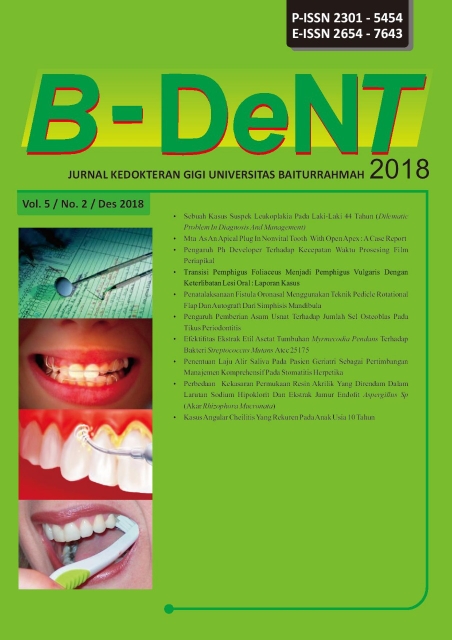
MTA AS AN APICAL PLUG IN NONVITAL TOOTH WITH OPEN APEX : A CASE REPORT
DOI:
https://doi.org/10.33854/jbd.v5i2.155Kata Kunci:
Plug apikal, gigi imatur, MTAAbstrak
Gigi imatur dengan nekrosis pulpa akibat trauma , karies atau pathosis pulpa. Dimana pembentukan dentin terganggu dan perkembangan akar berhenti sehingga terjadi perubahan warna gigi. Mineral trioxide aggregate (MTA) adalah bahan alternatif yang dapat digunakan untuk apeksifikasi apeks terbuka karena biokompatibilitasnya, nonmutagenisitas, non-neurotoksisitas, kemampuan regeneratif, dan sifat seal yang baik. Pada kasus ini penggunaan MTA sebagai plug apikal, pada gigi yang imature dengan apeks terbuka merupakan keputusan yang tepat. Tujuan dari laporan kasus ini adalah menjelaskan penggunaan MTA sebagai apical pluq pada gigi insisivus lateral maksila dengan diagnosis pulpa nekrosis dengan apeks terbuka dan dilanjutkan bleaching internal. Seorang pasien pria 43 tahun yang datang ke RSGM, Universitas Sumatera Utara dengan keluhan utama gigi yang berubah warna . Pemeriksaan radiografi menunjukkan apeks terbuka untuk gigi #12. Setelah cleaning and shapping dilakukan, kalsium hidroksida ditempatkan sebagai medikamen intracanal. MTA diletakkan kedalam saluran akar dengan ketebalan 3-4 mm menggunakan hand pluggers. Obturasi dengan gutta-percha termoplastik. Penggunaan MTA telah banyak direkomendasikan untuk kasus apeks terbuka. Karena memiliki apical seal yang baik, biokompatibilitas dan kemampuan regenerasi jaringan periodontal. Setelah di Follow up tidak adanya keluhan baik secara klinis maupun radiografi. Laporan kasus ini menunjukkan MTA sebagai bahan alternatif untuk apical plug pada metode konvensional apeksifikasi.Referensi
Kareem A. M. K, Rasha M. A. Managements of Immature Apex: Review Article. Modern Research in Dentistry. 2017;10(20)
Torabinejad M, Chivian N.Clinical applications of mineral trioxide aggregate. JEndod 1999;25:197-205
Abhijeet et al. Mineral Trioxide Aggregate as an Apical Plug Material in Tooth with Open Apex: A Case Report. International Journal of Scientific Study | February 2015 | Vol 2 | Issue 11
Abu-Hussein Muhamad et al. Single-Step Apexification with Mineral Trioxide Aggregate (MTA) –Case Reports IOSR Journal of Dental and Medical Sciences (IOSR-JDMS) e-ISSN: 2279-0853, p-ISSN: 2279-0861.Volume 15, Issue 2 Ver. VIII (Feb. 2016), PP 49-53
Asunción M M et al. Apexification with mineral trioxide aggregate plug in the upper anterior teeth: Presentation of three clinical cases. Edorium Journal of Dentistry, Vol. 1; 2014
Gangamwar Neha et al. Apexification with MTA placement – a case report IOSR Journal of Dental and Medical Sciences (IOSR-JDMS) e-ISSN: 2279-0853, p-ISSN: 2279-0861.Volume 14, Issue 10 Ver. I (Oct. 2015), PP 70-73
Goomer P, Jain RL. Comparison Of pulp revascularization & MTA apexification in adjacent central incisors with immature apex – A case report. Indian J Dent Sci 2014;6:92-1
Savadkouhi ST, Mohebbi P. Sealing ability of biomaterials as apical plug, A Literature Review. J Dent Health Oral Disord Ther 2015;2(6): 00068
Nagaveni et al. Management of tooth discoloration in non-vital endodontically treated tooth – A report of 6 year followup. J Clin Exp Dent. 2011;3(2):e180-3.
Bahuguna N. Cervical root resorption and non vital bleaching. Endodontology Volume: 25 Issue 2 December 2013
Haywood V.B, DiAngelis A.J. Bleaching the Single Dark Tooth. Inside Dentistry. September 2010
Unduhan
Diterbitkan
Terbitan
Bagian
Lisensi
Hak Cipta (c) 2019 Imelda Darmawi, Dennis Dennis, Trimurni Abidin

Artikel ini berlisensiCreative Commons Attribution-NonCommercial-ShareAlike 4.0 International License.
Authors who publish with this journal agree to the following terms: Authors retain copyright and grant the journal right of first publication with the work simultaneously licensed under a Creative Commons Attribution License (CC BY-NC-SA 4.0) that allows others to share the work with an acknowledgement of the work's authorship and initial publication in this journal.