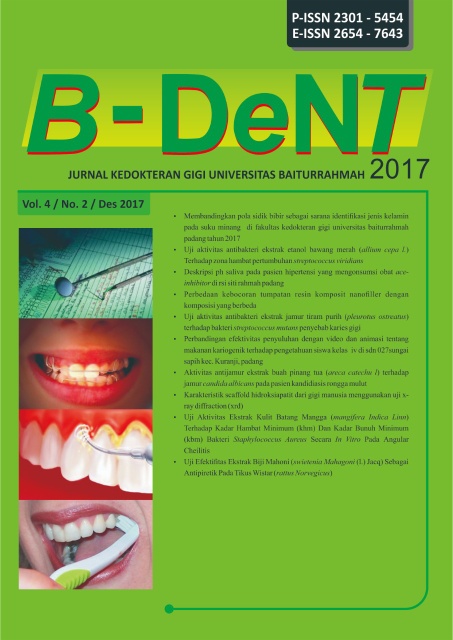
PERBEDAAN KEBOCORAN TUMPATAN RESIN KOMPOSIT NANOFILLER DENGAN KOMPOSISI YANG BERBEDA
DOI:
https://doi.org/10.33854/JBDjbd.101Kata Kunci:
Tingkat Kebocoran, Resin Komposit Nanofiller Komposisi A, Resin Komposit Nanofiller Komposisi BAbstrak
Resin komposit merupakan salah satu bahan kedokteran gigi yang terus berkembang hingga saat ini. Pengerutan selama polimerisasi merupakan salah satu kekurangan dari resin komposit sehingga dapat menyebabkan kebocoran mikro. Perbedaan komposisi berpengaruh terhadap terjadinya kebocoran mikro. Penelitian ini dilakukan untuk mengetahui perbedaan tingkat kebocoran tumpatan resin komposit nanofiller komposisi A dengan resin komposit nanofiller komposisi B. Jenis penelitian ini adalah penelitian eksperimental laboratorium dengan mengukur derajat kebocoran mikro pada gigi setelah diberi perlakuan kemudian membandingkan derajat kebocoran mikro antar kelompok. Analisa statistik menggunakan uji Mann-Whitney diperoleh nilai p= 0,014<0,05 artinya terdapat perbedaan tingkat kebocoran antara resin komposit nanofiller komposisi A dengan resin komposit nanofiller komposisi B. Resin komposit nanofiller komposisi A memiliki tingkat kebocoran yang lebih rendah dibandingkan resin komposit nanofiller komposisi B.Referensi
Apsari, A., Munadziroh, E., Yogiartono, M. 2009. Perbedaan Kebocoran Tepi Tumpatan Resin Komposit Hybrid yang Menggunakan System Bondim,ng Total Etch dan Self Etch. Jurnal PDGI. 58(3). Halaman 1-7.
Powers, John. M., Ronald. L., Sakaguchi. 2006. Craig’s restorative dental materials ed 13th. Philadelphia: Elsevier. Halaman 189-211.
Araujo, C. S. D., Ogliari, F. A., Piva, E. 2006. Microleakage of Seven Adhesive Systems in Enamel and Dentin. Journal Contemporary Dental Practice. 5(7). Halaman 26-33.
Henry Schein Halas dental. 2009. Henry Schein Shalfoon Everything Dental. Sydney: GC Corporation.
3M ESPE. 2016. Technical product profile – Filltek Z350 universal restorative, St paul.
Mukuan, T., Abidjulu. J., Wicaksono, D. 2013. Gambaran Kebocoran Tepi Tumpatan Pasca Restorasi Resin Komposit pada Mahasiswa Program Studi Kedokteran Gigi Angkatan 2005 2007. Jurnal e-GIGI. 1(2). Halaman 115-120.
Manappallil, J. 2003. Basic Dental Materials Edisi 10. India: Jaypee Brother. Halaman 143- 173.
Irmaleny. 2007. Perbedaan Kebocoran Mikro Restorasi Resin Komposit yang Menggunakan Dental Bonding Agent One Bottle dengan Self Etching Adhesives. Pertemuan Ilmiah Ilmu Kedoteran Gigi-IPROSI. Halaman 86-90.
Poggio, C., Chiesa, M., Scribante, A., Mekler, J., Colombo, M. 2013. Microleakage in Class II composite restorations with margins below the CEJ: In vitro evaluation of different restorative techniques. Med Oral Patol Oral Cir Bucal. 18 (5). Halaman 793-800.
Manhart, J., Chen, H, Y., Mehl, A., Weber, K., Hickel, R. 2001 Marginal quality and microleakage of adhesive class V restorations. J of Dentistry. 29. Halaman 123-130.
Sensi LG, Marson FC, Baratieri LN, Junior SM. 2005. Effect of Placement Techniques On The Marginal Adaptation of Class V Composite Restorations. The Journal of Contemporary Dental Practice. 6(4). Halaman 1-6
Chandra Sa, Chandra Sh, Chandra G. 2007.Textbook of Operative Dentistry (with MCQs). India: Jaypee Brothers Mediacal Publishers. Halaman 206-220.
Baum, L. 1997. Buku Ajar Ilmu Konservasi Gigi Edisi 3. Jakarta: EGC. Halaman 251-266.
Grag, N., Amit. 2013. Textbook of Operative Dentistry, 2nd ed. India: Jaypee. Halaman 299- 301.
Puckett, A. D., Fitchie, J. G., Karns, L., Dellinger, T. M., Inman, C. C. 2001. Microleakage of A compomer and Hybrid Ionomer. Quintessence Int. 32 (1). Halaman 49-53.
Sideridou, I., Tserki, V., Papanatasiou, G.2003. Study of Water Sorption, Solubility and Modulus Elasticity of Light Cured Dimethacrylate-Based Dental Resins. Biomaterials. 24. Halaman 655-665.
Feilzer, A. J., Dauviller, B. S. 2003. Effect of TEGDMA/Bis-GMA Ratio onStressDevelopmentand Viscoelastic Properties of Experimental two – paste Composites. J Dent Res. 82 (10). Halaman 824-828.
Unduhan
Diterbitkan
Terbitan
Bagian
Lisensi
Hak Cipta (c) 2019 Oniel Syukma Pertiwi, Darmawangsa Darmawangsa, Widyawati Widyawati

Artikel ini berlisensiCreative Commons Attribution-NonCommercial-ShareAlike 4.0 International License.
Authors who publish with this journal agree to the following terms: Authors retain copyright and grant the journal right of first publication with the work simultaneously licensed under a Creative Commons Attribution License (CC BY-NC-SA 4.0) that allows others to share the work with an acknowledgement of the work's authorship and initial publication in this journal.