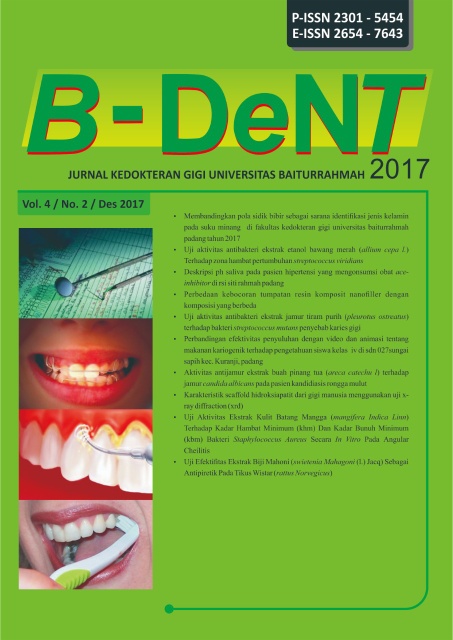
KARAKTERISTIK SCAFFOLD HIDROKSIAPATIT DARI GIGI MANUSIA MENGGUNAKAN UJI X-RAY DIFFRACTION (XRD)
DOI:
https://doi.org/10.33854/JBDjbd.105Keywords:
Gigi, Scaffold Hidroksipatit, Planetary Ball Mill, Uji X-ray DiffractionAbstract
Latar belakang: Resorpsi tulang alveolar diakibatkan oleh berbagai kasus, antara lain pencabutan gigi, trauma atau kecelakaan lalu lintas, kanker, tumor tulang, dan penyakit degeneratif yang semakin meningkat sehingga tulang alveolar tidak adekuat bagi penempatan dental implan. Gigi adalah bagian keras yang terdapat di dalam rongga mulut yang sering menjadi limbah setelah pencabutan. Gigi memiliki kandungan hidroksiapatit sekitar 60% yang hampir sama dengan tulang sehingga gigi dapat dimanfaatkan sebagai bahan scaffold hidroksiapatit. Tujuan: Penelitian ini bertujuan untuk mengetahui karakteristik scaffold hidroksiapatit dari gigi manusia dengan metode planetary ball mill dengan uji x-ray diffraction (XRD). Bahan dan metode: Penelitian ini merupakan jenis penelitian eksperimental laboratoris dengan menggunakan gigi yang telah diekstraksi dan dibuang bagian mahkota kemudian dilakukan perebusan, dihancurkan manual menggunakan palu, ditimbang menggunakan neraca, dan dikalsinasi pada suhu 600°C, 900°C, dan 1200°C, setelah itu dihaluskan dengan planetary ball mill dan dilakukan uji XRD. Hasil: Terdapat pola difraksi XRD yang berbeda pada setiap sampel, kandungan hidroksiapatit dengan komposisi berbeda pada setiap sampel, dan ukuran kristal yang berbeda yaitu 30.771797 nm pada suhu 600°C, 42.401917 nm pada suhu 900°C, dan 46.175893 nm pada suhu 1200°C. Simpulan: Dari hasil pegujian XRD didapatkan scaffold dengan tingkat kristalinitas berbeda menggunakan metode planetary ball mill.References
Budiatin, A, S., Muhammad, Z., Ferdiansyah, Fathia, R,. 2012. Efektivitas Matriks Komposit Bovine Hydroxyapatite – Gelatine sebagai Sistem Penghantaran Gentamisin dan Regenerasi Tulang Pada Bone Defect.
Chiapasco, M., Zaniboni, M., Rimondini, L,. 2007. Autogenous Onlay Bone Grafts vs. Alveolar Distraction Osteogenesis for the Correction of Vertically Edentulous Ridges: 2-4-year Prospetive Study on Humans.Clin Oral Implants Res. pp 432-40.
Mardas, N., D’Aiuto, F., Mezzomo, L., Arzoumanidi, M., Donos, N,. 2011. Radiographic Alveolar Bone Changes Following Ridge Preservationwith Two Different Biomaterials. Clin Oral Implants Res. pp. 416–423.
Johari. 2011. Email Gigi sebagai Objek Pemutihan. Retrieved June 12, 2016, from http://repository.ac.id/bitstream/123456789/21936/Chapter%2520II.pdf
Kim, Y, K., Su, G, K., Ji, S, O., Seung, C, J., Jun, S, S., Suk, Y, K., Soo, Y, L. 2011. Analysis of the Inorganic Component of Autogenous Tooth Bone Graft Material. America: Journal of Nanoscience and Nanotechnology, vol. 11. pp. 7442-7445.
Bhattacharjya, C. Srikanth, G., Abhay, T, K., Komal, S., Kalyana, C, P,. 2016. Tooth Derived Bone Graft Material,World Journal of Dentistry, pp. 32-35.
Kim, Y, Y. 2012. Bone Graft Material Using Teeth.Journal of the Korean Association of Oral and Maxillofacial Surgeons. pp. 134-138.
Pujiyanto, E. 2012. Studi Pemanfaatan Gipsum Lokal sebagai Bahan Dasar Bone graft Sintesis yang Berfungsi sebagai Scaffold.Disertasi Doktor, Universitas Gajah Mada. Retrieved June 12, 2016, from Electronic Theses & Disertation Universitas Gajah Mada.
Anwar, A, S and Solechan. 2014. Analisa Karakteristik dan Sifat Mekanik Scaffold Rekontruksi Mandibula dari Material Bhipasis Calsium Phosphate dengan Penguat Cangkang Kerang Srimping dan Gelatine Menggunakan Metode Functionally Graded Material. Jurnal SNATIF ke-1, pp. 129-136.
Adeyinka, A., Manish, G., Yamina, B., Andrew, M., Nashiru, B., Stephen, D,. 2016. Monitoring Model Drug Microencapsulation in PLGA Scaffolds Using X-Ray Powder Diffraction, Saudi Pharmaceutical Journal. Saudi Arabia: King Saud University. pp. 227-231.
Pudjiastuti, A, R. 2012. Preparasi Hidroksiapatit dari Tulang Sapi dengan Metode Kombinasi Ultrasonik dan Spray Drying. Tesis. Universitas Indonesia.
Ooi, C.Y., Hamdi, M., Ramesh, S. 2007. Properties of Hydroxyapatite Produced by Annealing of Bovine Bone. Ceramics International. 33. pp. 2117-2125.
Kusrini, E., Sontang, M. 2012. Characterization of X-Ray Diffraction andElectron Spin Resonance: Effects of Sentering Time and Temperature on Bovine Hydroxyapatite. Rad. Physical and Chem. 81. pp. 118-125.
Raksujarit, A., Pengpat, K., Rujijanagul, G., Tunkasiri, T. 2010. Processing and Properties of Nanoporous Hydroxyapatite Ceramics. Mater Des. pp. 1658-60.
Aoki, H. 1991. Science Medical Application of Hydroxyapatite. Tokyo: JAAS
Conz, M, B., Jose, M, G., Gloria, D, A. 2011. Hydroxiapatite Crystallinity Does Not Affect the Repair of Critical Size Bone Defects. J App Oral Sci, pp. 337-342.
Downloads
Published
Issue
Section
License
Copyright (c) 2019 Wenny Rosalina, Andries Pascawinata, Masra Roesnoer

This work is licensed under a Creative Commons Attribution-NonCommercial-ShareAlike 4.0 International License.
Authors who publish with this journal agree to the following terms: Authors retain copyright and grant the journal right of first publication with the work simultaneously licensed under a Creative Commons Attribution License (CC BY-NC-SA 4.0) that allows others to share the work with an acknowledgement of the work's authorship and initial publication in this journal.