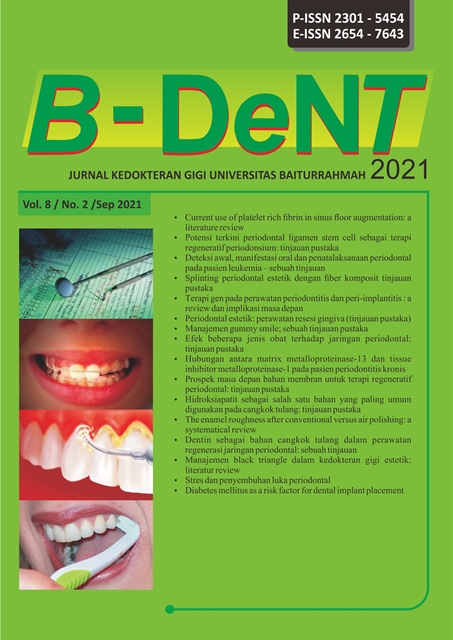
POTENSI TERKINI PERIODONTAL LIGAMEN STEM CELL SEBAGAI TERAPI REGENERATIF PERIODONSIUM: TINJAUAN PUSTAKA
DOI:
https://doi.org/10.33854/jbd.v8i2.887Keywords:
Periodontal Ligament, Periodontal Regeneration, Stem cellAbstract
Introduction: Regenerative therapies for periodontium aims to regenerate damaged periodontal tissue. Stem cell-based regenerative therapy may represent an effective therapeutic tool for periodontal regeneration. Periodontal ligament stem cells (PDLSCs) is a type of somatic stem cell that shows the potential to differentiate into several cell types and perform strong self-renewal. Therefore, PDLSCs are considered as a highly promising stem cell population for regenerative therapy in periodontium and need further knowledge regarding to the potential of using PDLSCs as a regenerative periodontium therapy. Literature Review: The periodontal ligament is a marker for stem cell, which is STRO-1. The STRO-1 marker is a colony-forming osteogenic precursor that can be isolated from bone marrow. The STRO-1 marker has the potential to be a phenotype of adipocytes, chondrocytes, and osteocytes. Markers of expression of STRO-1 from the surface of the periodontal ligament show that periodontal ligament cells have osteogenic precursors that can differentiate into osteoblasts. The potential multilineage differentiation of PDLSC including the adipogenic, chondrogenic, and osteogenic potential of PDLSC makes a promising cell source for cell-based regenerative periodontal therapy. Conclusion: The ability of PDLSCs in self renewal, multipotency, and stem cell immunomodulators, provides satisfactory results in the treatment of periodontal defects.References
Hajishengallis G. Periodontitis: from microbial immune subversion to systemic inflammation. Nat Rev Immunol. 2016;15(1):30–44.
Heidari Z, Moudi B, Mahmoudzadeh-Sagheb H. Immunomodulatory factors gene polymorphisms in chronic periodontitis: An overview. BMC Oral Health. 2019;19(1):1–15.
Rajabzadeh N, Fathi E, Farahzadi R. Stem cell-based regenerative medicine. Stem Cell Investig. 2019;6(1):18.
Mazini L, Rochette L, Amine M, Malka G. Regenerative capacity of adipose derived stem cells (ADSCs), comparison with mesenchymal stem cells (MSCs). Int J Mol Sci. 2019;20(10):1–30.
Deka N. Tissue engineering approach for periodontal regeneration. J Aplied Dent Sci. 2015;1(4):71–4.
Nosrat A, Kim JR, Verma P, Chand PS. Tissue engineering considerations in dental pulp regeneration. Iran Endod J. 2013;9(1):30–9.
Tatullo M, Marrelli M, Paduano F. The regenerative medicine in oral and maxillofacial surgery: The most important innovations in the clinical application of mesenchymal stem cells. Int J Med Sci. 2015;12(1):72–7.
Wojciech Z, Dobrzynski M. Stem cells: past, present, and future. Stem Cell Res Ther. 2018;10(1):68.
Yang X, Ma Y, Guo W, Yang B, Tian W. Stem cells from human exfoliated deciduous teeth as an alternative cell source in bio-root regeneration. Theranostics. 2019;9(9):2694–711.
Onizuka S, Iwata T. Application of periodontal ligament-derived multipotent mesenchymal Stromal cell sheets for periodontal regeneration. Int J Mol Sci. 2019;20(11):1–13.
Seyed Hossein Bassir. Potential for Stem Cell-Based Periodontal Therapy Seyed. J Cell Physiol. 2016;231(1):50–61.
Liu J, Li Q, Liu S, Gao J, Qin W, Song Y, et al. Periodontal Ligament Stem Cells in the Periodontitis Microenvironment Are Sensitive to Static Mechanical Strain. Stem Cells Int. 2017;1(1):1–13.
Monnouchi S, Maeda H, Yuda A, Hamano S, Wada N, Tomokiyo A, et al. Mechanical induction of interleukin-11 regulates osteoblastic/cementoblastic differentiation of human periodontal ligament stem/progenitor cells. J Periodontal Res. 2015;50(2):231–9.
Andrukhov O, Hong JSA, Andrukhova O, Blufstein A, Moritz A, Rausch-Fan X. Response of human periodontal ligament stem cells to IFN-γ and TLR-agonists. Sci Rep [Internet]. 2017;7(1):2–9. Available from: http://dx.doi.org/10.1038/s41598-017-12480-7
Issaranggun Na Ayuthaya B, Satravaha P, Pavasant P. Interleukin-12 modulates the immunomodulatory properties of human periodontal ligament cells. J Periodontal Res. 2017;52(3):546–55.
Kukolj T, Trivanović D, Djordjević IO, Mojsilović S, Krstić J, Obradović H, et al. Lipopolysaccharide can modify differentiation and immunomodulatory potential of periodontal ligament stem cells via ERK1,2 signaling. Vol. 233, Journal of Cellular Physiology. 2018. 447–462 p.
Iwasaki K, Komaki M, Yokoyama N, Tanaka Y, Taki A, Honda I, et al. Periodontal regeneration using periodontal ligament stem cell-transferred amnion. Tissue Eng - Part A. 2014;20(3–4):693–704.
Jung IH, Lee SH, Jun CM, Oh N, Yun JH. Characterization of the enhanced bone regenerative capacity of human periodontal ligament stem cells engineered to express the gene encoding bone morphogenetic protein 2. Tissue Eng - Part A. 2014;20(15–16):2189–99.
Jin H, Choung HW, Lim KT, Jin B, Jin C, Chung JH, et al. Recombinant Human Plasminogen Activator Inhibitor-1 Promotes Cementogenic Differentiation of Human Periodontal Ligament Stem Cells. Tissue Eng - Part A. 2015;21(23–24):2817–28.
Lim HC, Cha BY, Song SU, Yun JH. Harmine Promotes Periodontal Ligament Cell- Induced Tissue Regeneration. Oral Dis. 2018;24(3):456–64.
Chen FM, Gao LN, Tian BM. Treatment of periodontal intrabony defects using autologous periodontal ligamentstem cells : a randomized clinical trial. Stem Cell Res Ther. 2016;19(7):33.
Shalini HS, Vandana KL. Direct application of autologous periodontal ligament stem cell niche in the treatment of periodontal osseous defects : A randomized controlled trial. J Indian Soc Periodontol. 2018;22(6):503–12.
Downloads
Published
Issue
Section
License
Copyright (c) 2021 Gustivanny Dwipa A, Sri Oktawati

This work is licensed under a Creative Commons Attribution-NonCommercial-ShareAlike 4.0 International License.
Authors who publish with this journal agree to the following terms: Authors retain copyright and grant the journal right of first publication with the work simultaneously licensed under a Creative Commons Attribution License (CC BY-NC-SA 4.0) that allows others to share the work with an acknowledgement of the work's authorship and initial publication in this journal.