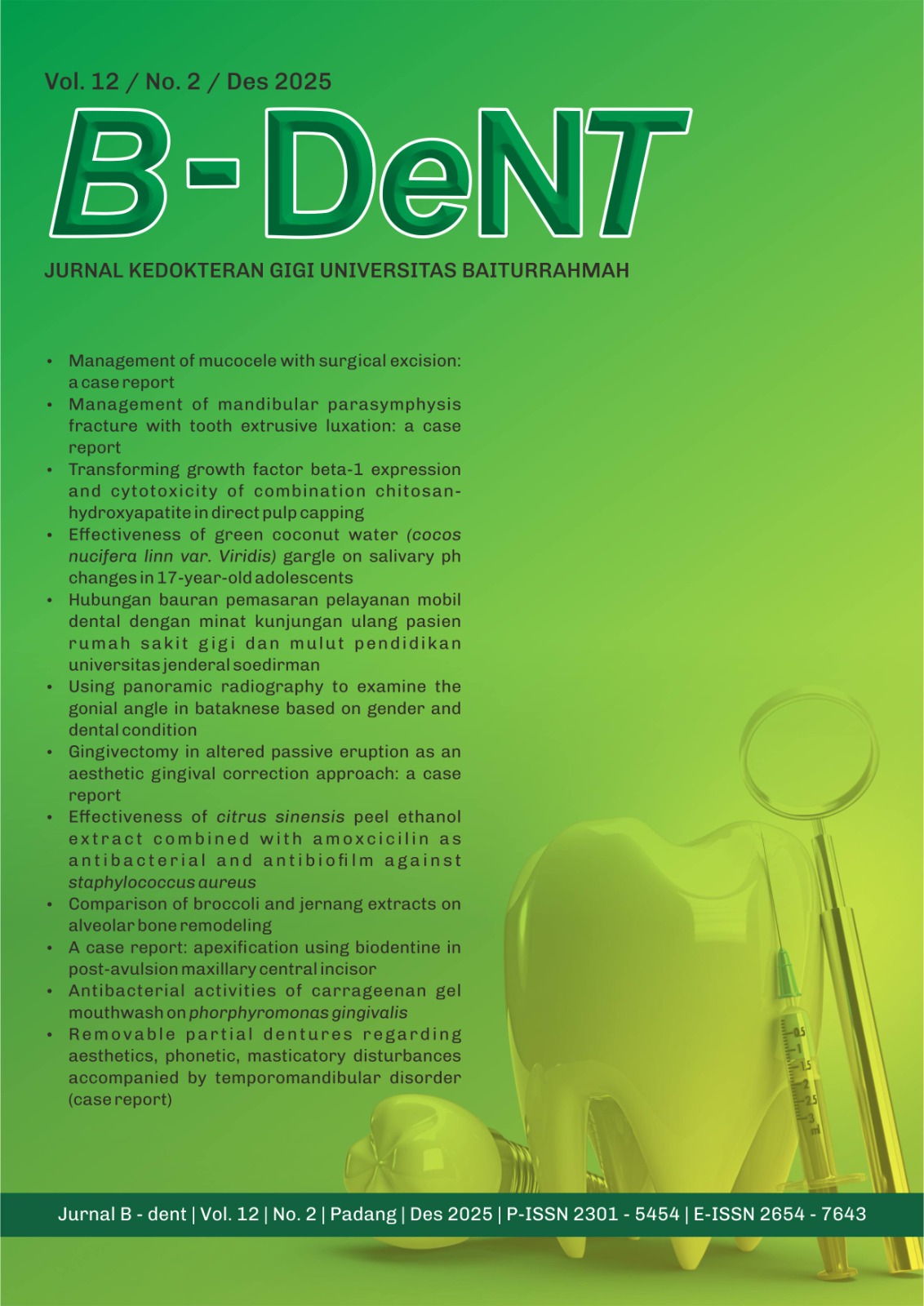
ANTIBACTERIAL ACTIVITIES OF CARRAGEENAN GEL MOUTHWASH ON Porphyromonas gingivalis
DOI:
https://doi.org/10.33854/jbd.v12i2.1532Keywords:
Kata Kunci, Aktivitas antibakteri, obat kumur hyrtogel karagenan, Porphyromonas gingivalisAbstract
Introduction: Porphyromonas gingivalis is a Gram-negative anaerobic bacterium involved in the pathogenesis of periodontal disease that can destroy tooth tissue and cause tooth loss. Carrageenan is one of the natural ingredients that can be utilized as a medicinal and antibacterial plant. Aim: The purpose of this study was to determine the antibacterial activity of carrageenan gel mouthwash against Porphyromonas gingivalis bacteria. Methods: Carrageenan extract was prepared and formulated into a mouthwash gel. The antibacterial activity of carrageenan gel mouthwash against Porphyromonas gingivalis was evaluated at concentrations of 0.5%, 1%, 2%, and 4%, as well as a positive control using chlorhexidine and a negative control using distilled water. This test was conducted using the disc paper diffusion method. Result: The 4% carrageenan gel mouthwash demonstrated a statistically significant antibacterial effect against Porphyromonas gingivalis (mean inhibition zone: 2.125 mm; p = 0.001). Lower concentrations (0.5 %, 1 %, and 2 %) showed no inhibitory activity. While the effect of the 4 % formulation was categorized as weak compared to chlorhexidine control, the results confirm its potential as an antimicrobial agent. Conclusion: The 4% carrageenan gel mouthwash demonstrated significant antibacterial activity against Porphyromonas gingivalis (p=0.001), indicating its potential as a bioactive agent in oral care. Further studies are needed to evaluate its clinical efficacy and safety. Keywords: antibacterial, carrageenan, mouthwash, periodontitisReferences
Surya, L.S., Setiawan and Besral (2019) „Hubungan faktor lokal, faktor sistemik dan faktor perilaku terhadap kejadian penyakit periodontal di Indonesia (Analisis Riskesdas)‟, Makassar Dental
Journal, 8(2), pp. 57–66.
Rohmawati, N. and Santik, Y.D.P. (2019) „Status Penyakit Periodontal pada Pria Perokok Dewasa‟, HIGEIA, 3(2). Available at: https://doi.org/10.15294/higeia/v3i2/254 97.
Banu, J. N., & Gayathri, V. (2016). Preparation Of Antibacterial Herbal Mouthwash Against Oral Pathogens. Int J Curr Microbiol App Sci, 5(11),205-21.
Leonarto, M.N. and Habar, E.H. (2017) „The impact of mouth-rinsing using hlorhexidine gluconate 0.2% to the amount of plaque-causing bacteria colonies in fixed orthodontic users‟, Journal of Dentomaxillofacial Science, 2(2), pp. 91–94. Available at: https://doi.org/10.15562/jdmfs.v1i3.320.
Putranto R.A. Jurnal Kedokteran Gigi Terpadu 1 (1), 2019
Lestari, F. and Susanti, I. (2020) „Tumbuhan obat berpotensi imunomodulator di suku anak dalam bendar bengkulu‟, JPBIO (Jurnal Pendidikan Biologi), 5(1), pp. 64–72. Available at: https://doi.org/10.31932/jpbio.v5i1.591.
Handayani, V. (2015) Pengujian Aktivitas Antibakteri Ekstrak Etanol Daun Kersen (Muntingia calabura L.
Mulyani, Y. and Bachtiar, E. (2013) „Peranan Senyawa Metabolit Sekunder Tumbuhan Mangrove terhadap Infeksi Bakteri Aeromonas Hydrophila Pada Ikan Mas (Cyprinus carpio L.)‟, Jurnal Akuatika , Vol. 1(1).
John W, Stanitski & Jurs, Peter C. (2005). “Chemistry The Molecular Science. Second Edition”. United States: Thomson Learning, Inc
Arnita Sari, Nurhikmatul Auliya Pharmaceutical and Traditional Medicine 2 (2), 53-59, 2018
Pelczar. M.J. & E.C.S. Chan. (1998). Dasar-Dasar Mikrobiologi. Jilid 1. UI Press. Jakarta. Efek Antibakteri Ekstrak Etanol Kulit Bawang Merah (Allium ascalonicum) terhadap Streptococcus sanguinis
Faradina A.S, Nyoman Mastra, I Wayan Karta Jurnal Portelkes 7 (2), 2019
Sihite G.S, Riani Setiadhi, Vinna K Sugiaman e-GiGi 11 (2), 152-160, 2023
Downloads
Published
Issue
Section
License
Copyright (c) 2026 maisie atttallah, Abu , Abu Bakar, Lestari , Lestari Citra

This work is licensed under a Creative Commons Attribution-NonCommercial-ShareAlike 4.0 International License.
Authors who publish with this journal agree to the following terms: Authors retain copyright and grant the journal right of first publication with the work simultaneously licensed under a Creative Commons Attribution License (CC BY-NC-SA 4.0) that allows others to share the work with an acknowledgement of the work's authorship and initial publication in this journal.