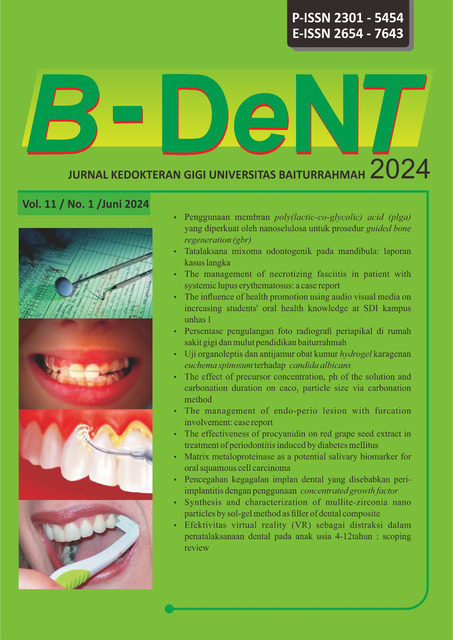
EFEKTIVITAS VIRTUAL REALITY (VR) SEBAGAI DISTRAKSI DALAM PENATALAKSANAAN DENTAL PADA ANAK USIA 4-12 TAHUN : SCOPING REVIEW
DOI:
https://doi.org/10.33854/jbd.v11i1.1094Keywords:
Virtual Reality, Distraksi, Penatalaksanaan Dental, Kecemasan Dental, Anak-AnakAbstract
Introduction: Dental anxiety in children aged 4-12 years is an obstacle in dental and oral health care. Anxiety management such as distraction is needed, namely a method to shift the child's focus to other things, such as the use of Virtual Reality (VR). Virtual Reality (VR) is an audiovisual distraction media that can reduce the level of anxiety and pain and unpleasant situations by displaying three-dimensional images along with VR glasses and their voices on the headset. Aim: The purpose of this study was to examine the advantages and disadvantages of Virtual Reality (VR) as a distraction in dental management in children aged 4-12 years, cases of dental management using VR and, the effectiveness of Virtual Reality (VR) as a distraction in dental management in children aged 4-12. Method: The literatures in this review was obtained through searches of the PubMed, Science Direct, and Google Scholar databases using specific keywords along with inclusion and exclusion criteria. Result: The findings of the review of the five articles indicated that virtual reality (VR) was an effective distraction for reducing anxiety and pain levels in children aged 4-12 years undergoing dental treatment. The results of other reviews did not provide specific age range for its use, the ideal duration for its use, the management of adverse effects following its use, or solutions for children who are unable to use it. Conclusion: Virtual reality represents a promising approach for the management of dental management in children aged 4-12 years.References
Milne R. and Munro M. Symptoms and causes of anxiety, and its diagnosis and management. Nurs Times. 2020;116(10):18–22.
World Health Organization. Depression and Other Common Mental Disorders Global Health Estimates. Vol. 1, World Health Organization. 2015. 1–24 p.
Hawari, Dadang. Manajemen stres, cemas dan depresi.Edisi ke 5. Jakarta: Gaya Baru Desmita; 2006
Novita CF, . S, Ferrina Siregar SI. Gambaran Tingkat Kecemasan Dental (Dental Anxiety) Terhadap Persepsi Nyeri Ketika Skeling Pada Pasien Di Rumah Sakit Gigi Dan Mulut Universitas Syiah Kuala. Cakradonya Dent J. 2018;9(1):40–3.
Mathius NPNE, Sembiring LS, Rohinsa M. Tingkat kecemasan dental anak usia 7-12 tahun yang akan melakukan ekstraksi gigi.Dental anxiety level of 7 - 12-years old children who will perform tooth extraction at dental hospital. Padjadjaran J Dent Res Students. 2019 Jul;3(1):33.
World Health Organization. WHO guideline: Use of multiple micronutrient powders for point-of-use fortification of foods consumed by infants and young children aged 6–23 months and children aged 2–12 years. World Health Organization. 2017. 1–60 p.
Murni. Perkembangan fisik, kognitif, dan psikososial pada masa kanak-kanak awal 2-6 tahun. Fak Tarb dan Kegur UIN Ar-Ranity. 2017;III:19–33.
Nurmalitasari F, Psikologi PM, Psikologi F, Gadjah U. Perkembangan Sosial Emosi pada Anak Usia Prasekolah. 2015;23(2):103–11.
Mar’atun AN. Periodesasi Masa Perkembangan Anak-Anak. Psikol Umsida. 2018;1–15.
Marinda L. ’Teori Perkembangan Kognitif Jean Pigeat dan Problematikanya Pada Anak Usia Sekolah Dasar. J An-Nisa J Kaji Peremp Keislam. 2020;13(1):116–52.
Izzaty RE. Perkembangan Anak Usia 7 - 12 Tahun. Psikol Pendidik dan Bimbing. 2010;4(3):1–11.
Marwansyah, Mahata IBE, Elianora S. Tingkat Kecemasan Pada Anak Dengan Metode Corah’s Dental Anxiety Scale (Cdas) Di Rumah Sakit Gigi Dan Mulut Baiturrahmah Padang. B-Dent J Kedokt Gigi Univ Baiturrahmah. 2018;5(1):20– 9.
Bezabih S, Fantaye W, Tesfaye M. Dental anxiety: Prevalence and associated factors, among children who visited Jimma University
Specialized
Hospital dental clinic. Ethiop Med J. 2013 Apr;51(2):115–21.
Kumar V, Goud E, Turagam N, Mudrakola D, Ealla K, Bhoopathi P. Prevalence of dental anxiety level in 6- to 12-year-old South Indian children. J Pharm Bioallied Sci. 2019
May;11(6):S321–4.
Sarapultseva M, Yarushina M, Kritsky I, Ibragimov R, Sarapultsev A. Prevalence of Dental Fear and Anxiety among Russian Children of Different Prevalence of Dental Fear and Anxiety among Russian Children of Different Ages : The Cross-Sectional Study. 2020;(July).
Dewi MK, Handoko SA, Widiasavitri PN. Faktor-Faktor yang Mempengaruhi Kecemasan Dental pada Anak Usia 8-12 Tahun di SD N 3 Peguyangan Denpasar. Bali Dent J. 2018;2(1):45–52.
Suryani L. Hubungan Kecemasan Anak Usia 7-14 Tahun Dengan Perawatan Gigi Di Poli Gigi Puskesmas Indrapuri Kabupaten Aceh Besar. J Abulyatama. 2019;77–86.
Kurniawati D, Amalia DP. Dental Anxiety Dan Keberhasilan Perawatan Endodontics Pada Anak Usia Prasekolah. J ilmu Kedokt gigi. 2019;2(2):4.
Cinantya T, Kurniawati D, Suyadi. Pengaruh Kecemasan Terhadap Derajat Perilaku Kooperatif Anak Usia 6-12 Tahun Selama Pemeriksaan Gigi Di Sd Ta’mirul Islam Surakarta. J Univ Muhammadiyah Surakarta. 2014;85(1Applied Microbiology and Biotechnology):2071–9.
Lamarca G de A, Vettore M V, Monteiro da Silva AM. The influence of stress and anxiety on the expectation, perception and memory of dental pain in schoolchildren. Dent J. 2018;6(4):1–10.
Soeparmin S. Distraksi Sebagai Salah Satu Pendekatan Yang Dilakukan Dalam Mencapai Keberhasilan Perawatan Gigi Anak. dentika Dent J. 2010;15(1):91–5.
Sharma A, Tyagi R. Behavior Assessment of Children in Dental Settings : A Retrospective Study. 2016;4(April 2011):35–9.
Lukitasari D. Pengaruh Clay Therapy Terhadap Kecemasan Anak Usia Prasekolah Yang Menjalani Prosedur Invasif Di Rsud Al-Ihsan. J Penelit Kesehat STIKes Dharma Husada Bandung. 2019;Volume XII(1):72–86.
Hima Agustina, Nikmatur Rohmah MAH. Pengaruh Distraksi Audiovisual Terhadap Respons Penerimaan Injeksi Intravena Pada Anak Pra Sekolah di RSD Kalisat Jember. Univ Muhammadiyah Jember. 2015;14(2):70–75
Mandal S. Brief Introduction of Virtual Reality & its Challenges. Int J Sci Eng Res. 2013;4(4):304–9.
Adel Zakhary S, Eid M, Wassef N. Audio-Visual Distraction Effect on Heart Rate in Children during Dental Treatment, A Randomized Clinical Trial. Egypt Dent J [Internet]. 2020 [cited 2021 Aug 2];66(1):27–34. Available from: https://journals.ekb.eg/ article_77496.html
Munn Z, Peters MDJ, Stern C, Tufanaru C, McArthur A, Aromataris E. Systematic review or scoping review. Guidance for authors when choosing between a systematic or scoping review approach. BMC Med Res Methodol. 2018 Nov;18(1):143.
Asl Aminabadi N, Erfanparast L, Sohrabi A, Ghertasi Oskouei S, Naghili
A.
The Impact of Virtual Reality Distraction on Pain and Anxiety during Dental Treatment in 4-6 Year-Old Children: a Randomized Controlled Clinical Trial. J Dent Res Dent Clin Dent Prospects [Internet]. 2012 [cited 2021 Aug 2];6(4):117–24. Available from: https://www.ncbi.nlm.nih.gov/ pmc/articles/pmc3529924/
Fakhruddin KS, Hisham EB, Gorduysus MO. Effectiveness of audiovisual distraction eyewear and computerized delivery of anesthesia during pulp therapy of primary molars in phobic child patients. Eur J Dent [Internet]. 2015 [cited 2021 Aug 2];9(4):470–5. Available from: https://www.thieme- connect.com/products/ejournals/abstrac t/10.4103/1305-7456.172637
Nuvvula S, Alahari S, Kamatham R, Challa RR. Effect of audiovisual distraction with 3D video glasses on dental anxiety of children experiencing administration of local analgesia: a randomised clinical trial. Eur Arch Paediatr Dent [Internet]. 2015 [cited 2021 Aug 2];16(1):43–50. Available from: https://link.springer.com/content/ pdf/10.1007/s40368-014-0145-9.pdf
Niharika P, Venugopal Reddy N, Srujana P, Srikanth K, Daneswari V, Sai Geetha K. Effects of distraction using virtual reality technology on pain perception and anxiety levels in children during pulp therapy of primary molars. J Indian Soc Pedod Prev Dent [Internet]. 2018 Oct 1 [cited 2021 Jun 2];36(4):364–9. Available from: https://www.jisppd.com/article.asp?issn
=0970-4388;year=2018;volume=36; issue=4; spage=364;epage=369;aulast
=Niharika
Shetty V, Suresh LR, Hegde AM. Effect of virtual reality distraction on pain and anxiety during dental treatment in 5 to 8 year old children. J Clin Pediatr Dent [Internet]. 2019 [cited 2021 Aug 2];43(2):97–102. Available from: https://meridian.allenpress.com
/jcpd/article-abstract/43/2/97/9801
Limantara G, Dwimega A, Sjahruddin
L. Perbedaan Kecemasan Dental pada Anak Usia 6 Tahun dan 12 Tahun (Kajian pada Sekolah Dasar Mahatma Gading , Kelapa Gading , Jakarta Utara). Semin Nas Cendekiawan. 2016;1–5.
Singh H, Rehman R, Kadtane S, Ranjan Dalai D, Jain CD. Techniques for the Behaviors Management in Pediatric Dentistry Children With Dental Anxiety. Int J Sci c Study. 2014;2(7).
Kaur R, Jindal R, Dua R, Mahajan S, Sethi K, Garg S. Comparative evaluation of the effectiveness of audio and audiovisual distraction AIDS in the management of anxious pediatric dental patients. J Indian Soc Pedod Prev Dent. 2015;33(3):192–203.
Al-Khotani A, Bello LA azi., Christidis
N. Effects of audiovisual distraction on children’s behaviour during dental treatment: a randomized controlled clinical trial. Acta Odontol Scand. 2016;74(6):494–501.
Srivastava K, Chaudhury S, Das R. Virtual reality applications in mental health: Challenges and perspectives. Ind Psychiatry J. 2014;23(2):83.
Chirico A, Lucidi F, De Laurentiis M, Milanese C, Napoli A, Giordano A. Virtual Reality in Health System: Beyond Entertainment. A Mini- Review on the Efficacy of VR During Cancer Treatment. J Cell Physiol. 2016;231(2):275–87.
Zanier ER, Zoerle T, Di Lernia D, Riva G. Virtual reality for traumatic brain injury. Front Neurol. 2018;9(MAY):1–4.
Felipe FA, de Carvalho FO, Silva ÉR, Santos NGL, Fontes PA, de Almeida AS, et al. Evaluation instruments for physical therapy using virtual reality in stroke patients: a systematic review. Physiother (United Kingdom) [Internet]. 2020;106(June):194–210. Available from: https://doi.org/10.1016/j.physio.2019.0 5.005
Erdogan B, Aytekin Ozdemir A. The Effect of Three Different Methods on Venipuncture Pain and Anxiety in Children: Distraction Cards, Virtual Reality, and Buzzy® (Randomized Controlled Trial). J Pediatr Nurs. 2021;58:e54–62.
Khandelwal M, Shetty RM, Rath S.Effectiveness of Distraction Techniques
in Managing Pediatric Dental Patients. Int J Clin Pediatr Dent. 2019;12(1):18– 24.
Sato K, Fukumori S, Miyake K. A Novel Application of Virtual Reality for Pain Control : Virtual Reality-Mirror Visual Feedback Therapy. 2012;
Chang E, Kim HT, Yoo B. Virtual Reality Sickness: A Review of Causes and Measurements. Int J Hum Comput Interact [Internet]. 2020;36(17):1658–
Available from: https://doi.org/ 10.1080/10447318.2020.1778351
Kurniawati D, Amalia DP. Dental Anxiety Dan Keberhasilan Perawatan Endodontics Pada Anak Usia Prasekolah. J ilmu Kedokt gigi. 2019;2(2):4.
Dahlander A, Soares F, Grindefjord M, Dahllöf G. Factors Associated with Dental Fear and Anxiety in Children Aged 7 to 9 Years. 2019;1–9.
Alsarheed M. Children ’ s Perception of Their Dentists. Eur J Dent. 2011;5(1):186–90.
Downloads
Published
Issue
Section
License
Copyright (c) 2024 Agung Anugerah Adha, Satria Yandi, Darmawangsa Darmawangsa

This work is licensed under a Creative Commons Attribution-NonCommercial-ShareAlike 4.0 International License.
<