
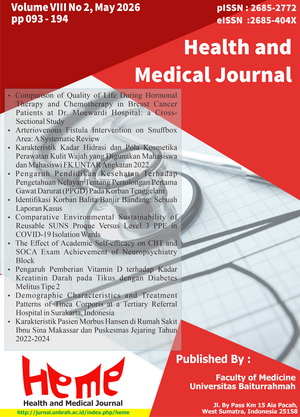
Comparative Environmental Sustainability of Reusable SUNS Proque Versus Level 3 PPE in COVID-19 Isolation Wards
DOI:
https://doi.org/10.33854/heme.v8i2.2144Keywords:
COVID-19, Personal protective equipment, Medical waste, Environmental sustainability, Reusable PPE, Circular economyAbstract
Background: The COVID-19 pandemic led to an unprecedented surge in the use of disposable personal protective equipment (PPE), contributing to a substantial increase in medical waste and environmental pollution. While Level 3 disposable PPE is widely used to protect healthcare workers, its environmental sustainability remains a growing concern. Reusable PPE systems, such as the Surgeons of Universitas Sebelas Maret Protective Equipment (SUNS Proque), have been developed as alternatives to mitigate environmental impacts while maintaining adequate protection. Objective: This study aimed to compare the environmental sustainability of reusable SUNS Proque PPE and conventional Level 3 disposable PPE used in COVID-19 isolation wards. Methods: An observational analytical cross-sectional study was conducted at Dr Moewardi Hospital in Indonesia. A total of 56 healthcare workers (physicians, nurses, and sanitation staff) who had experience using both PPE types participated. Environmental sustainability was assessed using a validated 10-item Likert-scale questionnaire covering recyclability, reusability, waste volume, material characteristics, waste segregation, and circular economy principles. Statistical analyses included Chi-square tests, independent t-tests, and Eta correlation analysis. Results: SUNS Proque PPE demonstrated significantly higher overall environmental sustainability compared with Level 3 PPE (p < 0.001). Significant differences were observed in recyclability (p = 0.025), design for reuse (p = 0.002), waste volume reduction (p = 0.017; Eta = 0.772), and waste segregation (p = 0.013). Waste volume emerged as the strongest determinant differentiating the two PPE systems. Other indicators, including material toxicity and non-incineration processing, showed no statistically significant differences. Conclusion: Reusable SUNS Proque PPE offers superior environmental sustainability compared with conventional disposable Level 3 PPE, particularly through substantial waste reduction. Integrating reusable PPE into hospital infection control strategies may support environmentally sustainable healthcare systems without compromising occupational safety.References
. World Health Organization. Shortage of personal protective equipment endangering health workers worldwide [Internet]. Geneva: WHO; 2020 [cited 2025 Jan 5].
Available from: https://www.who.int/news/item/03-03-2020-shortage-of-personal-protective-equipment-endangering-health-workers-worldwide
. Livingston E, Desai A, Berkwits M. Sourcing personal protective equipment during the COVID-19 pandemic. JAMA. 2020;323(19):1912–4. doi: 10.1001/jama.2020.5317
. Rowan NJ, Laffey JG. Challenges and solutions for addressing critical shortage of supply chain for personal and protective equipment (PPE) arising from Coronavirus disease (COVID-19) pandemic. Sci Total Environ. 2020;725:138532. doi:10.1016/j.scitotenv.2020.138532
. Chartier Y, Emmanuel J, Pieper U, et al. Safe management of wastes from health-care activities. 2nd ed. Geneva: World Health Organization; 2014.
. Klemeš JJ, Van Fan Y, Tan RR, Jiang P. Minimising the present and future plastic waste, energy and environmental footprints related to COVID-19. Renew Sustain Energy Rev. 2020;127:109883. doi: 10.1016/j.rser.2020.109883
. Sharma HB, Vanapalli KR, Cheela VS, et al. Challenges, opportunities, and innovations for effective solid waste management during and post COVID-19 pandemic. Resour Conserv Recycl. 2020;162:105052. doi: 10.1016/j.resconrec.2020.105052
. World Health Organization. Global analysis of health care waste in the context of COVID-19. Geneva: WHO; 2022.
. Prata JC, Silva ALP, Walker TR, Duarte AC, Rocha-Santos T. COVID-19 pandemic repercussions on the use and management of plastics. Environ Sci Technol. 2020;54(13):7760–5. doi: 10.1021/acs.est.0c02178
. Silva ALP, Prata JC, Walker TR, et al. Increased plastic pollution due to COVID-19 pandemic: challenges and recommendations. Chem Eng J. 2021;405:126683. doi: 10.1016/j.cej.2020.126683
. McQuerry MA, Griffin KA, Schaefer AN. Disposable versus reusable medical gowns: performance and environmental considerations. Am J Infect Control. 2020;48(4):436–42. doi: 10.1016/j.ajic.2019.10.028
. Singh N, Tang Y, Ogunseitan OA. Environmentally sustainable management of used personal protective equipment. Environ Sci Technol. 2020;54(14):8500–2. doi: 10.1021/acs.est.0c03022
. Rizan C, Bhutta MF, Reed M, Mortimer F. Environmental impact of personal protective equipment distributed for use by health and social care services in England in the first six months of the COVID-19 pandemic: a life cycle assessment. J R Soc Med. 2021;114(5):201–13. doi: 10.1177/01410768211001583
. Tonne C, Adair-Rohani H. Reusable personal protective equipment in low- and middle-income countries: environmental and supply chain perspectives. Lancet Planet Health. 2021;5(10):e677–8. doi: 10.1016/S2542-5196(21)00218-3
. Windfeld ES, Brooks MS-L. Medical waste management – A review. J Environ Manage. 2015;163:98–108. doi: 10.1016/j.jenvman.2015.08.013
. Lee BK, Ellenbecker MJ, Moure-Eraso R. Alternatives for treatment and disposal cost reduction of regulated medical wastes. Waste Manag. 2004;24(2):143–51. doi: 10.1016/S0956-053X(03)00106-2
. Keil M, Rizan C, Bhutta MF. Impact of switching from single-use to reusable healthcare products: environmental and economic implications. Eur J Public Health. 2023;33(1):56–63. doi: 10.1093/eurpub/ckad031
. Vozzola E, Overcash M, Griffing E. An environmental analysis of reusable and disposable surgical gowns. J Surg Res. 2020;257:158–67. doi: 10.1016/j.jss.2020.01.046
. Hiloidhari M, Jayaram V, Tiwari A. Environmental footprints of disposable and reusable personal protective equipment: a life cycle assessment of body coveralls. J Clean Prod. 2023;414:137637. doi: 10.1016/j.jclepro.2023.137637
. Eckelman MJ, Sherman JD. Environmental impacts of the U.S. health care system and effects on public health. PLoS One. 2016;11(6):e0157014. doi: 10.1371/journal.pone.0157014
. Patrício Silva AL, Prata JC, Walker TR. Rethinking PPE materials to mitigate environmental impacts during and after pandemics. Sustainability. 2021;13(13):7034. doi: 10.3390/su13137034
. Geissdoerfer M, Savaget P, Bocken NMP, Hultink EJ. The circular economy – a new sustainability paradigm. J Clean Prod. 2017;143:757–68. doi: 10.1016/j.jclepro.2016.12.048
Downloads
Published
Issue
Section
License
Copyright (c) 2026 pigur agus marwanto, Dony Marthen Bani, Darmawan Ismail

This work is licensed under a Creative Commons Attribution-NonCommercial-ShareAlike 4.0 International License.
Authors who publish with this journal agree to the following terms: Authors retain copyright and grant the journal right of first publication with the work simultaneously licensed under a Creative Commons Attribution License (CC BY-NC-SA 4.0) that allows others to share the work with an acknowledgement of the work's authorship and initial publication in this journal.