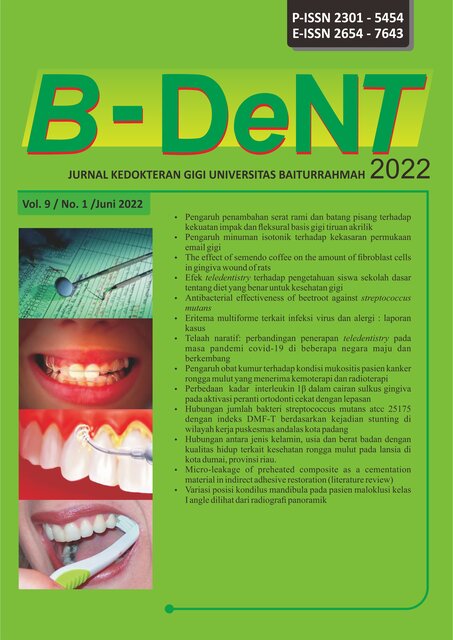
PENGARUH PENAMBAHAN SERAT RAMI DAN BATANG PISANG TERHADAP KEKUATAN IMPAK DAN FLEKSURAL BASIS GIGI TIRUAN AKRILIK
DOI:
https://doi.org/10.33854/jbd.v9i1.963Keywords:
Ramie Fiber, Banana Stem Fiber, Impact Strength, Flexural Strength, Acrylic Denture BaseAbstract
Introduction: Acrylic denture in its use often results in fractures and one of the causes is due to poor mechanical resistance, especially to impact strength. Several methods to prevent broken acrylic, include the addition of fibers that function as reinforcement. There are 2 types of fibers, synthetic and natural fibers. Synthetic fibers are relatively expensive, so an alternative is needed, namely the use of natural fibers (Ramie and banana stem). This study purposed to determine the effect of adding ramie fiber and banana stem to impact and flexural strength of acrylic denture base. Methods: Experimental Laboratory, number of 60 samples consisted of 30 samples for flexural and impact tests. The sample was an acrylic plate; size 65x10x2.5 mm for Flexural Test and 80x10x4 mm (Flatwise impact method without notched) for Impact Test. The fiber concentration added was 1.6% of the sample weight. The sample consisted of 3 groups, namely control, the addition of ramie and banana stem fibers. Flexural test with UTM and Impact test with Charpy method. Results: Flexural and impact strength mean value of the ramie fiber group had the highest value (132.7459MPa; 7.9859 x 10⁻³Joule/mm2), followed by the control group (99.8499MPa; 4.2757 x 10⁻³Joule/mm2) and smallest value was in banana midrib fiber group (91.6865MPa; 3.0303 x 10⁻³Joule/mm2). The LSD test of significance(p) between each group in flexural and Impact Strength tests showed a significant difference (p<0.05). Pearson correlation test showed a significant positive correlation between the two tests. Conclusion: The addition of ramie fiber can increase the impact and flexural strength of denture acrylic, but it is different from the addition of banana midrib fiber because the presence of flavonoids (phenol compounds) it contains causes a decrease in the strength of denture acrylic.References
Nandal, S., Ghalaut, P., Shekhawat, H. & Gulati, M. New Era in Denture Base Resins: A Review. Dent. J. Adv. Stud. Vol.01,Issue III [Internet], 136–143 (2013).
Felycia & Tarigan, S. Pengaruh pelapisan kitosan pada basis gigi tiruan resin akrilik polimerisasi panas terhadap penyerapan air dan kekuatan transversal. Padjadjaran J. Dent. Res. Students 5 (1) [Internet], 57–63 (2021). Avalaible from: http://jurnal.unpad.ac.id/pjdrs/article/view/29423/15344
Anusavice, K.J, Shen, C & Rawls, H.R. Phillips Science of Dental Materials. 12th ed , St. Louis Missouri, Elsevier Sounders, 53-61. (2013). ISBN: 9781437724189
Alla, R.K, Sajjan, S , Alluri, V.R, Ginjupalli, K. & Upadhya, N. Influence of Fiber Reinforcement on the Properties of Denture Base Resins. J. Biomater. Nanobiotechnol. 04 [Internet], 91–97(2013). Available from: http://dx.doi.org/10.4236/jbnb.2013.41012 Published
Mowade, T. K., Dange, S. P., Thakre, M. B. & Kamble, V. D. Effect of fiber reinforcement on impact strength of heat polymerized polymethyl methacrylate denture base resin: In vitro study and SEM analysis. J. Adv. Prosthodont. 4 (1) 30–36 (2012).
Kanie, T., Fujii, K., Arikawa K.I. Flexural Properties And Impact Strength Of Denture Base Polymer Reinforced With Woven Glass Fibers. Dent J Mat. 16 150–158 (2000).
Vallittu, P. K., Lassila, V.P & Lappalainen, R. Acrylic Resin-fiber Composite- part I: The Effect of Fiber Concentration on Fracture Resistance. Int. J. Prosth Dent. 71 (6), 607–612 (1994).
Raszewski, Z. & Nowakowska, D. Mechanical Properties of Hot Curing Acrylic Resins after Reinforced with Different Kinds of Fibers. Int. J. Biomed. Mater. Res. 1, 9 (2013).
Putranti, D. T. & Razalie, L. P. Pengaruh Penambahan Aluminium Oksida terhadap Kekuatan Fleksural dan Impak Pada Bahan Basis Gigi Tiruan Resin Akrilik Polimerisasi Panas. J. Ilm. PANNMED (Pharmacist, Anal. Nurse, Nutr. Midwivery, Environ. Dent. 13, 75–78 (2019).
Putri, M. L., Sugiatno, E. & Kusuma, H. A. Pengaruh Jenis Fiber dan Surface Treatment Ethyl Acetate terhadap Kekuatan Fleksural dan Impak pada Reparasi Plat Gigi Tiruan Resin Akrilik. J Ked Gi, 7 (2) ISSN 2086-0218, 111–117 (2016).
Hadianto, E., Widjijono & Herliansyah, M. K. Pengaruh Penambahan Polyethylene Fiber Dan Serat Sisal Terhadap Kekuatan Flek- sural Dan Impak Base Plate Komposit Resin Akrilik. IDJ 2 (2), 57–67 (2013).
Kusumastuti, A. Aplikasi Serat Sisal sebagai Komposit Polimer. J. Kompetensi Tek. 1 (1), 27–32 (2009).
Xu J, Li Y , Yu T & Cong L. Reinforcement of Denture Base Resin with Short Vegetable Fiber. J.Dental Mater. 29 1273–9 (2013).
Kunarto & Ernawan, E. Serat Pelepah Pisang Dan Eceng Gondok Sebagai Penguat Komposit dengan Variasi Arah Serat terhadap Uji Tarik dan Bending. J. Tek. Mesin UBL 5 (2), 1–4 (2018).
Supraptiningsih, S. Pengaruh Serbuk Serat Batang Pisang Sebagai Filler terhadap Sifat Mekanis dari Komposit PVC– CaCO3. Maj. Kulit, Karet, dan Plast. 28 (2), 79-87 (2012).
Vojdani, M. & Khaledi, A. A. R. Transverse Strength of Reinforced Denture Base Resin with Metal Wire and E-Glass Fibers. J of Dentistry, Tehran University Medical Sciences 3(4), 167–172 (2006).
Yu, S. H. et al. Reinforcing effects of different fibers on denture base resin based on the fiber type, concentration, and combination. Dent. Mater. J. 31 (6), 1039–1046 (2012).
Revised American Dental Association Specification No. 12 for denture base polymers. J.Am Dent Assoc 90, 451–8 (1975).
BSI, B. S. I. BSI Standards Publication Plastics — Determination of Charpy impact properties. BSI Stand. Publ. (2010).
Ku, H., Wang, H., Pattarachaiyakoop, N., dan Trada, M. A Review on the Tensile Properties of Natural Fiber Reinforced Polymer Composites. Composites Part B:Engineering, 42 (4). ISSN 1359-8368, 856–73. (2011).
Anusavice, Kenneth J, T. Phillips Buku ajar ilmu bahan kedokteran gigi. Trans. Johan Arif Budiman, Susi Puwoko, Lilian Juwono, Edisi 10 Jakarta EGC (2003).
Houston, T. E. Bite Force And Bite Pressure, Compare Of Humans and Dogs. 1–7 (2003).
Cullen, R. K., Singh, M. M. & Summerscales, J. Characterisation of Natural Fibre Reinforcements and Composites. J. Compos. 2013, 1–4 (2013). http://dx.doi.org/10.1155/ 2013/416501
ferata, Ramadhan Fido ; irfai, M. A. Pengaruh Panjang Serat Rami terhadap Kekuatan Tarik Komposit sebagai Material Penyusun Kaki Palsu. JTM 09, 123–128 (2021).
Astiti, N. P. A. Penentuan Kandungan Flavonoid, Tanin dan Vitamin C dari Ekstrak Metanol Pelepah Batang Pisang Batu (musa brachycarpa), Pisang Ketip (musa paradisiaca) dan Pisang Kepok (musa acuminata). Semin. Naional Sains dan Tekologi 3, 2–6 (2016).
Pribadi, S. B., Yogiartono, M. & Agustantina, T. H. Perubahan Kekuatan Impak Resin Akrilik Polimerisasi Panas dalam Perendaman Larutan Cuka Apel. J. Dentomaxillofacial Sci. 9, 13 (2010).
Annada, M & Zulkarnain M. Pengaruh Perendaman Resin Akrilik Polimerisasi Panas yang ditambahkan Serat Kaca dalam Ekstrak Daun Lidah Buaya (aloe vera) terhadap Kekuatan Impak. B-dent J. Kedokt. Gigi Univ. Baiturrahmah 7 (2), 143–152 (2020).
Ferasima, R., Zulkarnain, M. & Nasution, H. Pengaruh Penambahan Serat Kaca dan Serat Polietilen terhadap Kekuatan Impak dan Transversal pada Bahan Basis Gigitiruan Resin Akrilik Polimerisasi Panas. IDJ 2(1), 27–37 (2013).
Downloads
Published
Issue
Section
License
Copyright (c) 2022 Endang Prawesthi, Marzia M Tetelepta, Heldayani Heldayani

This work is licensed under a Creative Commons Attribution-NonCommercial-ShareAlike 4.0 International License.
Authors who publish with this journal agree to the following terms: Authors retain copyright and grant the journal right of first publication with the work simultaneously licensed under a Creative Commons Attribution License (CC BY-NC-SA 4.0) that allows others to share the work with an acknowledgement of the work's authorship and initial publication in this journal.