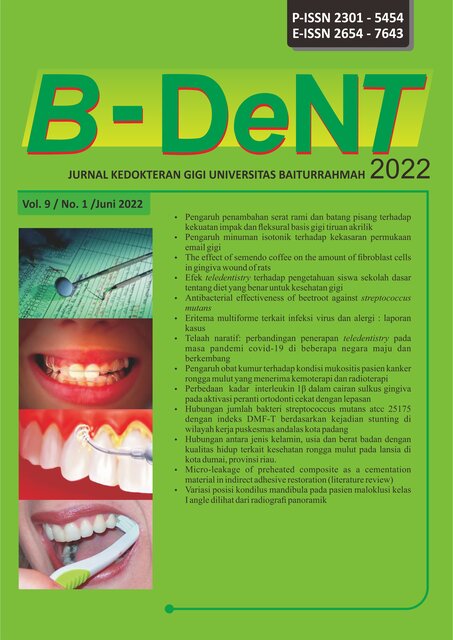
EFEK TELEDENTISTRY TERHADAP PENGETAHUAN SISWA SEKOLAH DASAR TENTANG DIET YANG BENAR UNTUK KESEHATAN GIGI
DOI:
https://doi.org/10.33854/jbd.v9i1.934Keywords:
teledentistry, caries, nutrition, educationAbstract
Introduction: Diet is one of the factors that influence the process of caries. Knowledge and understanding of diet patterns are needed from an early age to prevent caries. The Covid-19 pandemic hinders face-to-face education, but this can be overcome virtually through teledentistry. This study aimed to determine the level of knowledge of dental health in elementary school-age children on good dietary habits to prevent cavities through education teledentistry. Method: This cross-sectional analytic study was conducted on 61 3rd grade SD Kartika 1-11 Padang City students who met the inclusion and exclusion criteria. The purposive sampling technique made the selection of respondents. Education is done virtually with an online meeting application. Students' knowledge was measured using a questionnaire consisting of 13 closed questions which were given a value of 1 if the answer was correct and a value of 0 if the answer was incorrect. The data were processed with SPSS statistical software. Result: The results showed a significant increase in the average knowledge of respondents at pre-test2,64 ±1,059 increased to 4,98 ± 0,643 (p < 0.04) at post-test. Based on the results of the treatment effectiveness test/gain score, the result is 0,47. The intervention given has moderate effectiveness. Conclusion: This study concludes that education through teledentistry effectively increases knowledge about dental and oral health in elementary school students.References
Badan Penelitian dan. Pengembangan. Kesehatan. Kementerian. RI, 2018, “Riset Kesehatan Dasar (Riskesdas) 2018”, Jakarta
Rahina, Y., Digaa, C. I., Iwa, W. P., & Duarsa, P., 2019, “Tingkat Pengetahuan Kesehatan Gigi Pada Orang Tua Anak Usia Prasekolah”, Interdental: Jurnal Kedokteran Gigi, 15(2), 60-66. https://doi.org/10.46862/interdental.v15i2.593
Evans, E Whitney et al. “Dietary intake and severe early childhood caries in low-income, young children.” Journal of the Academy of Nutrition and Dietetics vol. 113,8 (2013): 1057-61. doi:10.1016/j.jand.2013.03.014
Forssten, S.D.; Björklund, M.; Ouwehand, A.C. Streptococcus mutans, Caries and Simulation Models. Nutrients 2010, 2, 290-298. https://doi.org/10.3390/nu2030290
Badrasawi, M.M., Hijjeh, N.H., Amer, R.S., Allan, R.M. and Altamimi, M., 2020. Nutrition awareness and oral health among dental patients in palestine: A cross-sectional study. International journal of dentistry, 2020.
Sivakumar, V., Jain, J., Tikare, S., Palliyal, S., Kulangara, S.K. and Patil, P., 2016. Perception of diet counseling among dental students in India. Saudi Journal of Oral Sciences, 3(1), p.36.
da Costa FD, Prashant GM, Sushanth VH, Imranulla M, Prabhu A, Kulkarni SS. Assessment of knowledge, attitude and practices of diet and nutrition on oral health among dental students. J Global Oral Health 2019;2(1):29-35.
Haryani, W., Setiyobroto, I., & Siregar, I., 2020, “The Influence of the Knowledge about Cariogenic Food Towards Dental Caries and Nutrition Status among 9-11 Years Old Children”. Jurnal Kesehatan Gigi 7 (1), 40-45
Astoeti, Tri Erri dan Armelia Sari, 2020, “Teledentistry”, Fakultas Kedokteran Gigi Universitas Trisakti. Jakarta.
Estai, M., Kanagasingam, Y., Mehdizadeh, M. et al. Teledentistry as a novel pathway to improve dental health in school children: a research protocol for a randomised controlled trial. BMC Oral Health 20, 11 (2020). https://doi.org/10.1186/s12903-019-0992-1
Nila Kasuma, Murniwati, Dedi Sumantri, Reni Nofika, Surya Nelis, Susi, Aria Fransiska, 2020, “Effectiveness of Online
Oral Health Education During the Covid-19 Pandemic”, Indian Journal of Forensic Medicine & Toxicology, 14(4), pp. 4240-4248. doi: 10.37506/ijfmtv14i4.12306.
Dian, IR., dan Rukiyanti, 2018, “Developing popup book learning media to improve cognitive ability of children age 4-5 years”, Journal of education and humanitis research, 249: 65. 10.
Isrofah., dan Eka, N., 2010, “Pengaruh pendidikan kesehatan gigi terhadap pengetahuan dan sikap anak usia sekolah SD Boto Kembang Kulonprogo, Jogjakarta”, Majalah Kedokteran Gigi;1(1): 5
Jáuregui-Lobera, I., Martínez-Gamarra, M., Montes-Martínez, M., & Martínez-Quiñones, J. V., 2020, “Storytelling as instrument of communication in health contexts”, Journal of Negative and No Positive Results, 5(8), 863-890.
Susanne Walan & Ann-Britt Enochsson, 2019, “The potential of using a combination of storytelling and drama, when teaching young children science”, European Early Childhood Education Research Journal, 27:6, 821-836, DOI: 10.1080/1350293X.2019.1678923
Downloads
Published
How to Cite
Issue
Section
License
Copyright (c) 2022 fildzah nurul fajrin, Nila Kasuma, Haria Fitri, Reno Wiska Wulandari, Wulandani Liza Putri

This work is licensed under a Creative Commons Attribution-NonCommercial-ShareAlike 4.0 International License.
Authors who publish with this journal agree to the following terms: Authors retain copyright and grant the journal right of first publication with the work simultaneously licensed under a Creative Commons Attribution License (CC BY-NC-SA 4.0) that allows others to share the work with an acknowledgement of the work's authorship and initial publication in this journal.