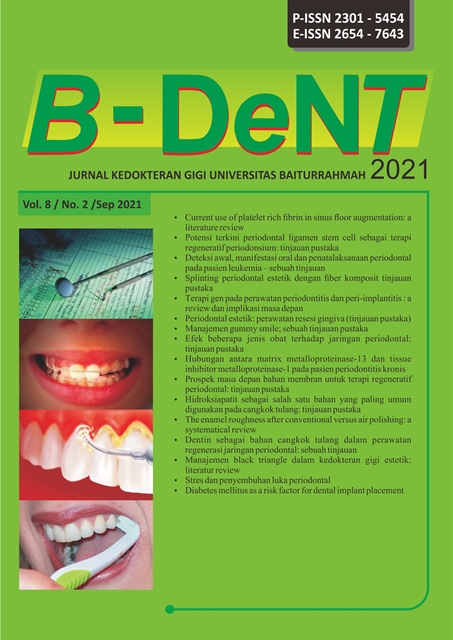
THE ENAMEL ROUGHNESS AFTER CONVENTIONAL VERSUS AIR POLISHING: A SYSTEMATICAL REVIEW
DOI:
https://doi.org/10.33854/jbd.v8i2.896Keywords:
Air polishing, Conventional polishing, Enamel roughness, Scanning electron microscopeAbstract
Introduction: Polishing after scaling and root planing provides a smoother tooth surface and improves patient convenience. Recently, a novel polishing system using the air-driven high-pressured device is introduced, but the advantage over conventional polishing is still questionable. This article aims to provide a comprehensive literature study regarding dental polishing by comparing the surface roughness after conventional and air polishing systems. To conduct this review, Preferred Reporting Items for Systematic Reviews and Meta-Analyses (PRISMA) guidelines were followed. Studies published before November 29th, 2019 were systematically reviewed under “air-polishing”, “enamel roughness”, “conventional polishing”, “scanning electron microscopy” and “10 years” publication dates files with PubMed and Google Scholar database. Review: Dental polishing assists the removal of dental plaque and stains to achieve healthy periodontal tissue. The air-polishing device cleans the deeper surface with minimal damage on enamel, the efficacy depends on handpiece degree angulation to the enamel surface, time of exposure, and the powder particle size used. The air-driven device takes a shorter working time and is easy to handle compared to conventional polishing. Prophylaxis paste in conventional polishing is abrasive, hence flattening the enamel surface. Conclusion: Both techniques show efficacy in polishing procedures, nevertheless air polishing provides a smoother surface compared to conventional devices.References
Camboni S, Donnet M. Tooth Surface Comparison after Air Polishing and Rubber Cup: A Scanning Electron Miscrocope Study. J Clin Dent 2016, 27:13-18.
Saurabh S Patil., et.al. A Comparative Evaluation of Plaque-Removing Efficacy of Air Polishing and Rubber-Cup, Bristle Brush
With Paste Polishing on Oral Hygiene Status: A Clinical Study. J Int Soc Prevent Communit Dent 2015. 5:457-462.
Gisela M C., et.al. Roughness of Human Enamel Surface Submitted to Different Prophylaxis Methods. J Clin Pediatr Dent 2008, 32(4): 299–304.
Chowdhary Z, Mohan R. Efficiency Of Three Different Polishing Methods On Enamel And Cementum: A Scanning Electron Microscope Study. J Indian Soc Periodontology 2018, 22:18-24.
Tuzcel NY, Akkaya M, Karacaoglu F. A Comperative Evaluation of 3 Different Polishing Methods on Tooth Surface Roughness. Jornal of Biomedical Sciences 2016, 6; 12: 1-6
Sinjari B, D’Addazio G, Bozzi M, dkk. SEM Analysis of Enamerl Abrasion afterAir Polishing Treatment with Erythritol, Glycine and Sodium Carbonate. Coatings 2019, 549: 1-9.
Graumann SJ., Sensat ML, Stoltenberg JL. Air Polishing: A Review of Current Litelature. Journal of Dental Hygiene 2013, 6; 87: 173-180.
Ramfjord S, Ash MM Jr. Periodontology and Periodontics. Philadelphia, WB sounders Company. 2015.
Sawai MA, Bhardwaj A, Jafri Z, Sultan N, Daing A. Tooth polishing: The current status. J Indian Soc Periodontol 19: 375-380.
Petersilka GJ, Bell M, Häberlein I, Ehl A, Hickel R, et al. (2003) In vitro evaluation of novel low abrasive air polishing powders. J Clin Periodontol 30: 9-13.
Madan C, Bains R, Bains VK. Tooth polishing: Relevance in present day periodontal practice. J of Indian Society Periodontology 2019, 13: 58-9.
Erdemir U, Yildiz E, Eren MM, Oszoy A, Topcu FT. Effects of polishing systems on the surface roughness of tooth-colored
materials. J of Dental Sciences 2013, 8:2; 160-9.
Kaur A, Gupta M, Das D, Sachdeva S, Jain S. Tooth polishing - A mouthful of history. J of Periodontology and Implant 2018, 3;2: 63-
Chandra D, Bagchi S. Tooth Polishing: An Overview. International J of Preventive and clinicsl dental Res 2018;5 (2):77-8.
Scheibe KGBA, Almeida KGB, Medeiros IS, Costa JF, Alves CMC. Effect of different polishing systems on the surface roughness of
microhybrid composites. J Appl. Oral Sci 2009
Downloads
Published
How to Cite
Issue
Section
License
Copyright (c) 2021 David Tjoea, Maria Theresia Beatrix, Prajna Metta, Aldilla Miranda, Amaliya Amaliya

This work is licensed under a Creative Commons Attribution-NonCommercial-ShareAlike 4.0 International License.
Authors who publish with this journal agree to the following terms: Authors retain copyright and grant the journal right of first publication with the work simultaneously licensed under a Creative Commons Attribution License (CC BY-NC-SA 4.0) that allows others to share the work with an acknowledgement of the work's authorship and initial publication in this journal.