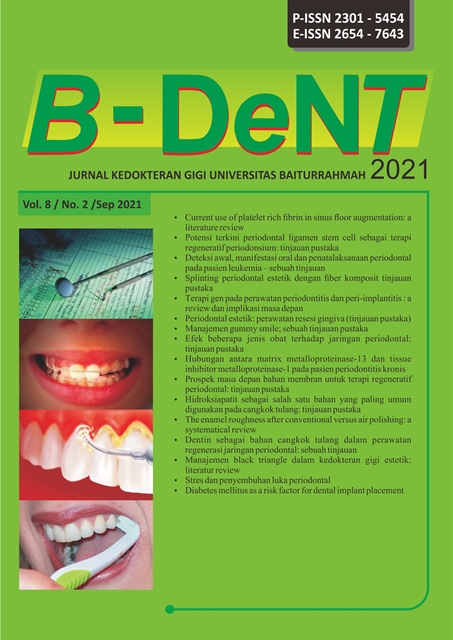
MANAJEMEN BLACK TRIANGLE DALAM KEDOKTERAN GIGI ESTETIK: LITERATUR REVIEW
DOI:
https://doi.org/10.33854/jbd.v8i2.888Keywords:
Aesthetic Dentistry, Black Triangle, Interdental PapilaAbstract
Introduction: The black triangle is a condition where the interdental papila does not cover the space between teeth which can interfere with aesthetics, pronunciation and cause food impaction, so preservation of papila in the aesthetic area is something that must be considered in periodontal treatment. This article aims to review the literature on definitions, etiology, classification, and various considerations in handling black triangle cases in aesthetic dentistry. Review: Interdental papilae not only function as biological barriers for the periodontal structure beneath but also have an important role in aesthetics. Handlers in black triangle cases include non-surgical involves crossdepartment (Periodontia, Orthodontia, Conservation) and surgical. The etiology of interdental papila loss is multifactorial, so it is important to establish an adequate diagnosis to obtain an appropriate treatment plan. Non-surgical techniques can be performed by making prosthesis, restoration, and orthodontic treatment. While surgical techniques include reconstructive, preservation, and recontouring of interdental papilae. Conclusion: Black triangle treatment can provide maximum results by considering various factors, both etiology, appropriate treatment plan, and alternative treatments so that it can provide satisfaction for patients.References
Lubis PM, Nasution RO. Black Triangle , Etiology and Treatment Approaches : Literature Review. 2018;8(Idcsu 2017):241–4.
Singh VP, Uppoor AS, Nayak DG, Shah D. Black triangle dilemma and its management in esthetic dentistry. [Internet]. Vol. 10,
Dental research journal. 2013. p. 296–301. Available from: http://www.ncbi.nlm.nih.gov/pubmed/24019795%0Ahttp://www.pubmedcentral.nih.gov/articlerender.fcgi?artid=PMC3760350
Park JAEH, D P. Esthetic Considerations in Interdental Papila: Remediation and Regeneration. 2010;22(1):18–28.
Joanne Cunliffe AR. A Literature Review of the Treatment of Black Triangles. 2019. p. 1–5.
Oliveira JD De, Storrer CM, Sousa AM, Lopes TR, Deliberador TM, Profissional M, et al. Papilary regeneration: anatomical aspects and treatment approaches. Rsbo. 2012;9(4):448–56.
An SS, Choi YJ, Kim JY, Chung CJ, Kim KH. Risk factors associated with open gingival embrasures after orthodontic treatment. Angle Orthod. 2018;88(3):267–74.
Y. Ravishankar, K. Srinivas, S.K. Sharma SPK. Management of black triangles and gingival recession: a prosthetic approach. Indian J Dent Sci. 2012;4 (1):141–5.
Tanwar J HS. Hyaluronic acid: Hope of light to black triangles. J Int Soc Prev Community Dent. 2016;6:497-500.
Ravishankar Y, Srinivas K, Sharma SK SK. Management of Black Triangles and Gingival Recession: A Prosthetic Approach. Indian J Dent Sci. 2012;4:141-145.
Chang LC. The association between embrasure morphology and central papila recession: A noninvasive assessment method. Chang Gung Med J. 2007;30(5):445–52.
Prato GP, Rotundo R, Cortellini P, Tinti C AR. Interdental papila management: A review and classification of the therapeutic
approaches. Int J Periodontics Restor Dent. 2004;24:246–55.
Moskowitz ME NA. Determinants of dental esthetics: a rational for smile analysis and treatment. Compend Contin Educ Dent. 1995;16:1164.
Takei HH. The Interdental Space. Dent Clint North Am. 1980;26:169–76.
Ko-Kimura N, Kimura-Hayashi M, Yamaguchi M, Ikeda T, Meguro D et al. Some factors associated with open gingival embrasures following orthodontic treatment. Aust Orthod J. 2003;19:19–24.
Deepalakshmi D, Ahathya RS, Raja S KA. Surgical Reconstruction of lost interdental papila: a case report. PERIO. 2007;4(3):229–34.
Tahir H, Irawaty A, Oktawati S, Adam M, Gani A, Rizki SS. Journal of International Dental and Medical Research ISSN 1309-100X http://www.jidmr.com Application of Platelet Rich Fibrin Arni Irawaty Djais and et al. 2019;12:1189–95.
Saket K. Palatal pedicle graft for management of a severe case of black triangle: A case report. Int J Oral Craniofacial Sci. 2019;5:020–3.
Downloads
Published
Issue
Section
License
Copyright (c) 2021 Afdalia Annisa, Arni Irawaty Djais

This work is licensed under a Creative Commons Attribution-NonCommercial-ShareAlike 4.0 International License.
Authors who publish with this journal agree to the following terms: Authors retain copyright and grant the journal right of first publication with the work simultaneously licensed under a Creative Commons Attribution License (CC BY-NC-SA 4.0) that allows others to share the work with an acknowledgement of the work's authorship and initial publication in this journal.