
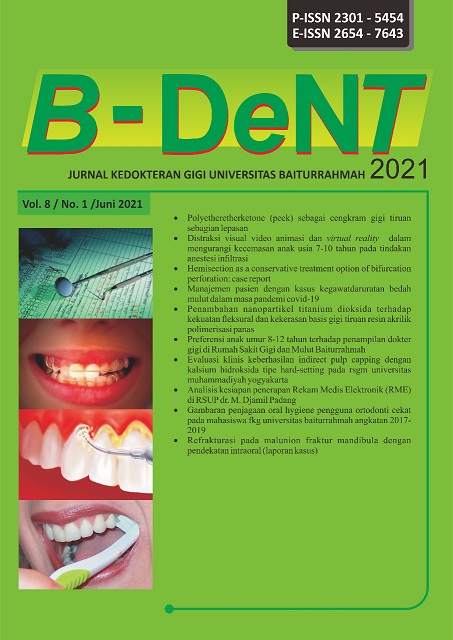
EVALUASI KLINIS KEBERHASILAN INDIRECT PULP CAPPING DENGAN KALSIUM HIDROKSIDA TIPE HARD-SETTING PADA RSGM UNIVERSITAS MUHAMMADIYAH YOGYAKARTA
DOI:
https://doi.org/10.33854/jbd.v8i1.779Keywords:
Clinical Evaluation, Hard-setting Type Calcium Hydroxide, Indirect Pulp CappingAbstract
Introduction: Pulp capping material is required to have the component which stimulates tertiary dentin formation, maintain pulp vitality, release fluoride to prevent secondary caries, antibacterial properties, attached to the dentine and restorative materials. Indirect pulp capping by using a hard-setting type calcium hydroxide could prevent the caries to reach the pulp. The successful indirect pulp capping treatment can be indicated from the clinical examination (cold test, percussion, and palpation test), radiographic, and histology of the treated teeth. The purpose of this study was to determine the clinical evaluation of successful indirect pulp capping with a hard-setting type calcium hydroxide at the Dental Hospital, Universitas Muhammadiyah Yogyakarta. Methods: Clinical evaluation of successful indirect pulp capping at the Dental Hospital Universitas Muhammadiyah Yogyakarta was done by using secondary data of the patient’s medical records who visited the dental hospital to had indirect pulp capping between 2010-2011. results : showed successful treatment of indirect pulp capping seen from clinical evaluation before and after treatment. Before indirect pulp capping treatment, the number of samples that categorized as good are 215 respondents (34.8%), satisfactory in 349 respondents (56.5%), dissatisfactory are 54 respondents (8.7%), and poor is 0% with a total of 618 respondents (100%). After indirect pulp capping treatment, patients were recalled for follow-up. Cases categorized as good at 1-4 weeks are 479 respondents (93.6%), 5-8 weeks are 202 respondents (94.4%), and >8 weeks are 287 respondents (91,4%). The average rate of successful treatment which is categorized as good was 93.1%.References
Nurhidayat, O., Tunggul, E., & Wahyono, B. (2012). Perbandingan Media Power Point dengan Flip Chart dalam Meningkatkan Pengetahuan Kesehatan Gigi dan Mulut. Unnes Journal Public Health, 1 (1). 32.
Walton, R. E., & Torabinejad, M. (2008). Prinsip & Praktik Ilmu Endodonsia (ed 3). Jakarta: EGC. 429-430.
Dumsha, T. C., & Gutmann, J. L. (2000). Clinician’s Endodontic Handbook. USA: Lexi-comp. 232-235.
Ingle, Bakland, & Baumgartner. (2008). Ingle’s Endodontics (6th ed). India: BC Decker Inc. 528.
Chong, B. S. (2010). Harty’s Endodontic in Clinical Practice (6th ed). London: Churchill Livingstone Elsevier. 59.
Mc.Cabe, J. F., & Walls, A. W. G. (2008). Applied Dental Materials (9th ed.). United Kingdom: Blackwell Munksgaard. 281.
VanNoort, R. (2007). Introduction to Dental Material (3rd ed). China: Mosby Elsevier. 172-174.
Jamjoon, H. M. (2008). Clinical Evaluation of Directly Pulp Capped Permanent Teeth with Glass Ionomer Materials. Cairo Dental Journal, 24 (2). 178-179.
Torabzadeh, H., & Asgary, S. (2013). Indirect Pulp Therapy in a Symptomatic Mature Molar Using Calcium Enriched Mixture Cement. Journal of Conservative Dentistry, 16 (1). 83.
Al-Zayer, M. A., Straffon, L. H., Feigal, R. J., & Welch, K. B. (2003). Indirect Pulp Treatment of Primary Posterior Teeth: A Retrospective Study. Scientific Article, 25 (1). 32, 34.
Rukmo, M. (2011). Perkembangan Metode Penelitian Kesembuhan Penyakit Periapikal setelah Perawatan Endodontik. Proceeding Kongres IKORGI ke IX dan Seminar Ilmiah Nasional Recent advances in Conservative Dentistry. 8-9.
Franzon, R., et al. (2007). Clinical and Radiographic Evaluation of Indirect Pulp Treatment in Primary Molars: 36 Months Follow-up. American Journal of Dentistry, 20 (3). 190.
Murray, P. E., & Godoy, F. G. (2006). The Incidence of Pulp Healing Defects with Direct Capping Materials. American Journal of Dentistry, 19 (3). 171.
Chandra, S., Chandra, S., & Chandra, R. (2000). A Textbook of Dental Materials. New Delhi: Jaypee. 147-149.
Hargreaves, K. M., & Goodis, H. E. (2002). Seltzer and Bender’s Dental Pulp. China: Quintessence Publishing. 41, 60, 233, 314.
Council on Clinical Affairs. (2014). Guideline on Pulp Therapy for Primary and Immature Permanen Teeth. American Academy of Pediatric Dentistry, 37 (6). 245.
Bjorndal, L. (2008). Indirect Pulp Therapy and Stepwise Excavation. Journal of Endodontics, 34 (7S). 32.
Downloads
Published
How to Cite
Issue
Section
License
Copyright (c) 2021 erma sofiani, Rizqylayli Fajriyani

This work is licensed under a Creative Commons Attribution-NonCommercial-ShareAlike 4.0 International License.
Authors who publish with this journal agree to the following terms: Authors retain copyright and grant the journal right of first publication with the work simultaneously licensed under a Creative Commons Attribution License (CC BY-NC-SA 4.0) that allows others to share the work with an acknowledgement of the work's authorship and initial publication in this journal.