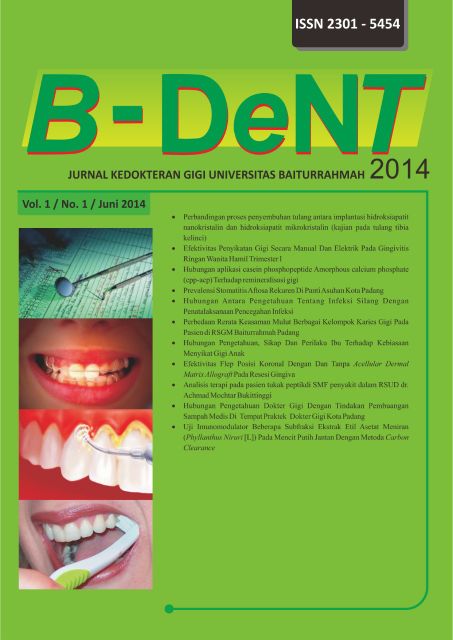
ANALISIS TERAPI PADA PASIEN TUKAK PEPTIKDI SMF PENYAKIT DALAM RSUD DR. ACHMAD MOCHTAR BUKITTINGGI
DOI:
https://doi.org/10.33854/jbd.v1i1.53Keywords:
Tukak Peptik, Pemeriksaan Fisik, TerapiAbstract
Telah dilakukan penelitian tentang hubungan hasil pemeriksaan fisik dengan pilihan terapi pada pasien tukak peptik di SMF penyakit dalam RSUD Dr. Achmad Mochtar Bukittinggi. Tujuan penelitian ini untuk memahami apakah hasil pemeriksaan fisik telah menjadi rujukan dalam pemberian terapi pada pasien tukak peptik.Penelitian ini merupakan penelitian prospektif dan pengambilan sampel dilakukan dengan metoda purposive sampling. Data dikumpulkan dari bulan Februari sampai April 2012 yang diambil dari rekam medik pasien rawat inap serta menggali informasi dari pasien untuk mendapatkan faktor penyebab tukak peptik. Hasil penelitian menunjukkan dari 50 pasien penderita tukak peptik diduga tukak disebabkan oleh Helicobacter pylori(38%), stres (36%), penggunaan OAINS (10%) dan Helicobater pylori-OAINS (16%).Terapi yang diberikan adalah ranitidin, omeprazol, lansoprazol, antasida, sukrafalt, dan tidak ditemukan terapi yang menggunakan antibiotik.Hubungan terapi yang diberikan dengan pemeriksaan fisik menunjukkan dari 50 pasien, 23 pasien (46%) yang ada hubungan antara hasil pemeriksaan fisik dengan pilihan terapi tukak peptik, sisanya 27 pasien (54%) tidak ada hubungan antara hasil pemeriksaan fisik dengan pilihan terapi tukak peptik. Hasil menunjukkan bahwa pemeriksaan fisik belum dijadikan rujukan dalam pemberian terapi.Diperlukan pemeriksaan Helicobacter pylori untuk memastikan faktor penyebab penyakitnya.References
Crawford J.M, 2005, The Gastrointestinal Tract, In V. Kumar, A.K. Abbas, N.Fausto ed.: Pathologic Basic of Disease. 7th ed. Philadelphia: Elsevier Saunders. p. 816-817.
Aziz, A.R., Achmad, F., 2006, Infeksi Helicobacter pylori dan Penyakit Gastroduodenal, ed: Buku Ajar Ilmu Penyakit Dalam ed IV Jilid I, FKUI. p.329
Dipiro, J.T., Cecily, Barbara, G.S., Terry, L.S., 2009, Pharmacotherapy Handbook , Seventh Edition, McGraw-Hill Companies, Inc.
Kuipers, E.J., Thijs, J.C., Festen, H.P., The Prevalence of Helicobacter pylori in Peptik Ulcer Disease, Aliment Pharmacol Ther 1995; 9(Suppl 2):59–69.
Kimble, M.A., Young, L.E., Kradjan, W.A., Guglielmo, B.J., Alldredge, B.K., Corelli, R.L., 2005, Applied Therapeutics : The Clinical Use of Drugs, 8th Ed., Lippincot Williams & Wilkins, USA.
Bhowmik, Chiranjib, K.K., Tripathi, Pankaj, K.P., Sampath, K., 2010,Recent Trends of Treatment and Medication Peptik Ulcerative Disorder, Pharm Tech, Vol2(1): 970-980.
Hardman, J.G., Limbird, L.E., Molinof, P.B., Ruddon, R.W., 2006, The Pharmacological Basic of Therapeutics, 9th Ed., The McGraw-Hill Companies Inc., USA.
Longe, R.L., 1995, Teaching Physical Assessment to Doctor of Pharmacy Students, American Journal of Pharmaceutical Education, Vol. 59: 151-154.
Berardi, R.R., Welage, L.S, 2005, Peptic Ulcer Disease, In Dipiro J.T., Talbert R.L.,Yee G.C., Matzke G.R., Wells B.G., Posey L.M, ed: Pharmacotherapy a Pathophysiologic Approach, 6th ed. USA: McGraw-Hill Companies. p. 630
Zeitoun, A., Mayam, Z., Hani, D., 2011, Stres Ulcer Prophylaxis Guidelines. Word Journal GastrointestinalPharmacology and Therapeutics, 2(4): 27-35.
Valle, D.J., Chey, W.D., Scheiman, J.M., Acid peptik disorders. In: Yamada, T., Aplers, D. H., Kaplowitz, N., Textbook of Gastroenterology, 4th ed, 2003, Philadelphia, Lippincott Williams & Wilkins:1321–1376.
Xiang, Z., Min, J.S., Huai, D.H., 2004, Chronik Gastritis Rat Model and Role of Inducing Factor, Word Journal of Gastroenterology, China.
Awofisayo, O.S., Awofisayo, O.A., Iferi, I.I., & Akpan, O.E. 2008. The Pattern of Sale and Use of Non-Steroidal Anti-Inflammatory Drugs in Rural and Urban Centres in Nigeria.Tropical Journal of Pharmaceutical Research, 7 (3) : 1013-1018
Goodman & Gilman’s. 2008. Manual of Pharmacology and Therapeutics. United States : The McGraw-Hill Companies
Risser, A., Donovan, D., Heintzman, J., & Page, T. 2009. NSAID Prescribing Precaution.American Family Physician, 80 (12) : 1371-1378
Roach, Sally. 2006. Introductory Clinical Pharmacology (8thed). United States : Lippincoot Williamsand Wilkins
Talley, Nicholas, J., 2003, Dyspepsia, Gastroenterology; 125: 1219-1226.
McLoughlin, Ramona, M., Colm, A., O'Morain, Humphrey, J., O'Connor, 2005, Eradication of Helicobacterpylori: recent advances intreatment, Fundamental& Clinical Pharmacology19: 421-427.
Chey, W.D., Wong, B.C., 2007, American college of Gastroenterology Guideline on the Management of Helicobacter pylori, Am J Gastroenterol; 102: 1808-1825.
Malfertheiner, P., Megraude, F., Banzzoli, F., 2007, The European Helicobacter Study Group. Curret concepts in the management of Helicobacter pylori infection: the Maastricht III Consensus Report. Gut; 56: 772-781.
Susilowati, E. 26 Mei 2011 .Mengenal Lebih Dekat “Farmasi Klinik” (2), Diakses pada 1 Mei 2012 dari http://www.putraindonesiamalang.or.id/mengenal-lebih-dekat-%E2%80%9Cfarmasiklinik%E2%80%9D-2.htm.
Published
Issue
Section
License
Copyright (c) 2018 Suhatri Suhatri, Hansen Hansen, Hengky Hengky

This work is licensed under a Creative Commons Attribution-NonCommercial-ShareAlike 4.0 International License.
Authors who publish with this journal agree to the following terms: Authors retain copyright and grant the journal right of first publication with the work simultaneously licensed under a Creative Commons Attribution License (CC BY-NC-SA 4.0) that allows others to share the work with an acknowledgement of the work's authorship and initial publication in this journal.