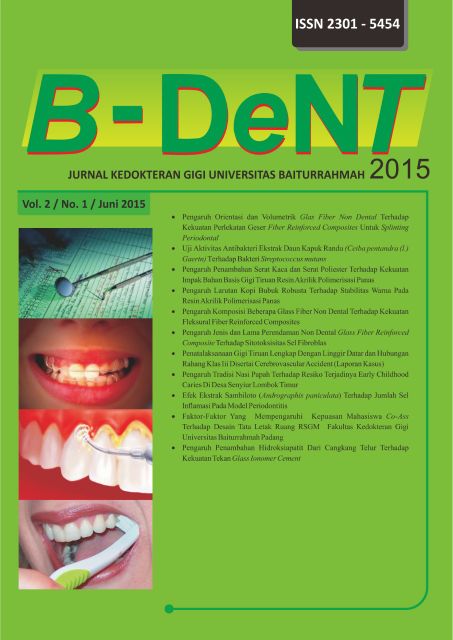
PENGARUH ORIENTASI DAN VOLUMETRIK GLASS FIBER NON DENTAL TERHADAP KEKUATAN PERLEKATAN GESER FIBER REINFORCED COMPOSITES UNTUK SPLINTING PERIODONTAL
DOI:
https://doi.org/10.33854/JBDjbd.5Keywords:
Glass Fiber Non Dental, Orientasi Fiber, Volumetrik Fiber, Kekuatan Perlekatan Geser, Splinting PeriodontalAbstract
Fiber Reinforced Composite (FRC) menggunakan E-glass fiber dental dalam bidang kedokteran gigi telah banyak diaplikasikan secara klinis, salah satunya dalam aplikasi splinting periodontal. Ketersediaan E-glass fiber dental di Indonesia masih terbatas dengan harga relatif mahal. Terdapat glass fiber non dental di Indonesia yang banyak digunakan bidang teknik, dengan harga terjangkau. Tujuan dari penelitian ini untuk mengetahui pengaruh orientasi dan volumetrik glass fiber non dental terhadap kekuatan perlekatan geser FRC pada splinting periodontal. Bahan penelitian berupa glass fiber non dental yang terdiri dari tiga jenis yaitu glass fiber mats (LT, China), glass fiber roving (CMAX, China), dan glass fiber woven roving (HJ, China), serta E-glass fiber dental (Fiber-Splint, Polidentia SA, Switzerland). Objek dibagi menjadi 8 kelompok, masing-masing kelompok terdiri atas 4 sampel. Kelompok I (kontrol) tanpa penambahan glass fiber non dental, kelompok II E-glass fiber dental 2,8 vol%, dan kelompok III - VIII terdiri dari glass fiber non dental mats, glass fiber non dental roving, dan glass fiber non dental woven roving, dengan fraksi volumetrik 2,8 dan 5,4 vol%. Seluruh sampel direndam dalam air destilasi selama 24 jam pada suhu 37o C. Pengujian kekuatan perlekatan geser menggunakan Universal Testing Machine. Data dianalisis menggunakan ANAVA dua jalur, uji t dan LSD. Hasil penelitian menunjukkan rerata kekuatan perlekatan geser (MPa) terendah pada kelompok tanpa fiber (kontrol) (8,95 ± 0,95) dan tertinggi pada 5,4 vol% glass fiber non dental woven roving (14,11 ± 0,35). Hasil analisis ANAVA dua jalur menunjukkan variabel orientasi dan volumetrik glass fiber non dental memberikan pengaruh signifikan (p<0,05). Uji post hoc LSD dan uji t menunjukkan perbedaan signifikan (p<0,05) pada seluruh kelompok perlakuan untuk variabel orientasi dan volumetrik. Kesimpulan penelitian ini adalah orientasi dan volumetrik glass fiber non dental memberikan pengaruh terhadap peningkatan kekuatan perlekatan geser FRC.References
Strassler, H.E., 2004, Periodontal Splinting with Fiber Reinforced Composite Resin. Compendium of Continuing Education Dent. 25: 53-59.
Suwandi, T., 2010, The Initial Treatment of Mobile Teeth Closure Diastema in Chronic Adult Periodontitis. Periodonti Departement, Faculty of Dentistry, Trisakti University. Jurnal PDGI. Vol. 59, No. 3,. p.105 - 109.
Paddmanabhan, P.P, Chandrasekaran, S.C., Ramya, V., Manisundar., 2012, Tooth Splinting Using Fiber Reinforced Composite & Metal -A Comparison. A Case Report. Indian Journal of Multidisciplinary Dentistry, Vol. 2, Issue 4.
Alla, R.K., Sajjan, S., Alluri, V.R., Ginjupalli, K., dan Upadhya, N., 2013, Influence of Fiber Reinforcement on The Properties of Denture Base Resins. J of Biomat and Nanobiotech. 4 : 91-97.
Raszewski, Z., dan Nowakowska, D., 2013, Mechanical Properties of Hot Curing Acrylic Resin after Reinforced with Different Kinds Of Fibers. Int. J. of Biomed. Mat Research. 1(1) : 9-13.
Zhang, M., dan Matinlinna, J.P., 2012, EGlass Fiber Reinforced Composites in Dental Applications. Silicon. 1-5.
Stromberg., 2012, Glass Fiber Reinforced Gypsum. http://www.strombergarchitectural.com/materials/gfrg. diunduh 16 April 2015
Johnson,T.,2015, Uses of Fiberglass. http://composite.about.com/od/aboutglass/a/Uses-Of-Fiberglass.htm. diunduh 16 April 2015
Sari, W.P., Sumantri, D., Imam, D.N.A., Sunarintyas, S., 2014, Pemeriksaan Komposisi Glass Fiber Komersial Dengan Teknik X-Ray Fluorescence Spectrometer (XRF). Jurnal B-Dent. Vol.1 (2). 83-160
Scribante, A., Cacciafesta,V., Sfondrini, M.F., 2006, Effect of Various Adhesive Systems on The Shear Bond Strength of Fiber-Reinforced Composite. American Journal of Orthodontics Dentofacial Orthopedic.130:224-7
Oilo, G., 1992, Biodegradation of Dental Composites/Glass Ionomer Cements. Adv Dent Res., 6: 50-54.
Vallittu, P.K., 2001, Strength and Interfacial Adhesion of FRC-Tooth System. In: Vallittu P.K, editor. The Second International Symposium on Fiber-Reinforced Plastics in Dentistry. Nijmegen, The Netherlands. University of Turku. Publishing Office. p.2–28.
Curtis, R.V., and Watson, T.F., 2008, Dental Material Imaging Testing and Modelling. Woodhead Publishing Limited Cambridge, England.
Juloski, J., Beloica, M., Goracci, C., Chieffi, N., Giovannetti, A., Vichi, A., Vulicevic, Z.R., dan Ferrari, M., 2012, Shear Bond Strength to Enamel and Flexural Strength of Different Fiber-Reinforced Composites. J.Adhes. Dent. 14(10) : 1-8.
Foek, D.L., Özcan, M., Krebs, E., Sandham, A., 2009, Adhesive Properties of Bonded Orthodontic Retainers to Enamel: Stainless Steel Wire vs Fiber-Reinforced Composites. J Adhes Dent , 11: 381-390.
Tezvergil, A, Lassila LVJ., Vallittu P.K., 2005, The Shear Bond Strength of Bidirectional and Random-Oriented Fiber-Reinforced Composite to Tooth structure. J Dent ;33:509-16
ISO 11405 : 2003, Dental Materials - Testing of Adhesion to Tooth Structure. 2nd ed.
Fabricio, A.R., Renato, Q.C.J., Fabíola, L.P.P., Helcio, R.N.J., Carvalho, R.F., Özcan, M., 2013, Evaluation of Bond Strength Between Glass Fiber and Resin Composite Using Different Protocols for Dental Splinting. European Journal of General Dentistry . Vol 2 ; Issue 3. p.281-285.
Frese, C., Decker, C., Rebholz, J., Stucke, K., Staehle, H.J., Wolff, D., 2014, Originaland Repair Bond Strength of Fiber-Reinforced Composites In Vitro. Dental materials. 30: 456–462
Callaghan, D.J., Vaziri, A., Hashemi, H.N., 2006, Effect of Fiber Volume Fraction and Length The Wear Characteristics of Glass Fiber-Reinforced Dental Composites. J Dent Material. 22 ; p. 84-93.
Alander, P., Lasilla, L.V.J., Valittu, P.K., 2005, The Span Length and Cross-Sectional Design Affect Values of Strength. Dent Material, 21: 347 - 353.
Abdulmajeed, A.A., Narhi, T.O., Vallittu, P.K., Lassila, L.V.J., 2011, The Effect of High Fiber Fraction on Some Mechanical Properties of Unidirectional Glass Fiber-Reinforced Composite.Dent Material ;27:313-321.
Siva L., Winowlin J.J.T., Sankar L., Amico S.C., Ravindran D., 2013, Effect of Fiber Volume Fraction on The Mechanical Properties of Coconut Sheath/USP Composite. J Manufacturing Engineering. 8(1): 60-63
Downloads
Published
Issue
Section
License
Copyright (c) 2018 Dedi Sumantri, Siti Sunarintyas, Dahlia Herawati

This work is licensed under a Creative Commons Attribution-NonCommercial-ShareAlike 4.0 International License.
Authors who publish with this journal agree to the following terms: Authors retain copyright and grant the journal right of first publication with the work simultaneously licensed under a Creative Commons Attribution License (CC BY-NC-SA 4.0) that allows others to share the work with an acknowledgement of the work's authorship and initial publication in this journal.