
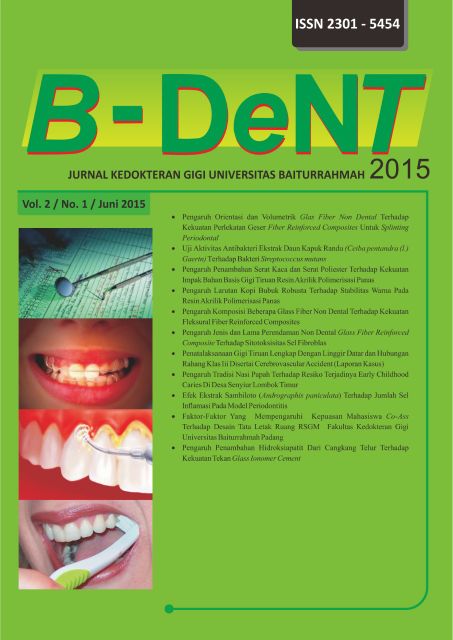
PENGARUH PENAMBAHAN HIDROKSIAPATIT DARI CANGKANG TELUR TERHADAP KEKUATAN TEKAN GLASS IONOMER CEMENT
DOI:
https://doi.org/10.33854/JBDjbd.42Keywords:
Glass Ionomer Cement, Hidroksiapatit, Cangkang Telur, Kekuatan TekanAbstract
Glass Ionomer Cement (GIC) memiliki sifat-sifat yang menguntungkan sebagai material restorasi. Namun, penggunaannya terbatas karena GIC memiliki kekuatan tekan yang rendah. Berbagai penelitian dilakukan untuk meningkatkan kekuatan tekan GIC, salah satunya penambahan hidroksiapatit ke bubuk GIC. Hidroksiapatit dapat disintesis dari larutan kimia atau berbagai limbah alam, misalnya cangkang telur, melalui metode presipitasi. Tujuan penelitian ini adalah untuk mengetahui pengaruh penambahan hidroksiapatit dari cangkang telur terhadap kekuatan tekan GIC Fuji IX (GC Corporation). Pembuatan 32 silinder GIC berdiameter 4mm dan tinggi 6mm dibagi menjadi 2 kelompok, yaitu: kelompok GIC tanpa penambahan hidroksiapatit sebagai kelompok kontrol (n=16) dan kelompok GIC dengan penambahan 8% hidroksiapatit sebagai kelompok uji (n=16). Kekuatan tekan diukur dengan Universal Testing Machine. Data dianalisis menggunakan uji T tidak berpasangan. Hasil pengukuran rata-rata kekuatan tekan GIC kelompok kontrol adalah 104,33±1,36 MPa dan kelompok uji adalah 109,52±1,58 MPa. Hasil uji T pada data tersebut menunjukkan perbedaan signifikan antar kelompok (p<0,05). Kesimpulan penelitian ini adalah penambahan hidroksipatit dari cangkang telur ke bubuk GIC dapat meningkatkan kekuatan tekan GIC.References
McCabe, John F. Applied Dental Materials Ninth Edition. UK: Blackwell Munksgaard; 2008.P. 245-256.
Robert G, Craig. Restorative Dental Materials Eleventh Edition. St. Louis: Mosby; 2002.P. 212-214.
Kerby RE. Shear resistance of silver and stainless steel-reinforced glass-ionomer cements bonded to enamel and dentin. International Journal of Prosthodontics. 1992;5(5):469-74.
Lucas ME, Arita K, Nishino M. Toughness, bonding and fluoride-release properties of hydroxyapatite-added glass ionomer cement. Biomaterials. 2003;24(21):3787-94.
Lohbauer U, Walker J, Nikolaenko S,dkk. Reactive fibre reinforced glass ionomer cements. Biomaterials. 2003;24:2091-907.
Moshaverinia A, Ansari S, Moshaverinia M, dkk. Effects of incorporation of hydroxyapatite and fluoroapatite nanobioceramics into conventional glass ionomer cements (GIC). Acta biomaterialia. 2008;4(2):432-40.
Sadat-Shojai M, Khorasani MT, Dinpanah-Khoshdargi E, dkk. Synthesis methods for nanosized hydroxyapatite with diverse structures. Acta biomaterialia. 2013;9(8):7591-621.
Saeed AM, Hassan RA, Tahjeel KM. Synthesis of calcium hydroxyapatite powder from hen’s eggshell. Iraqi Journal of Physics 2011;9(16):24-8.
Fazel-Rezai, Reza. Biomedical engineeringfrontiers and challenges. Croatia: Intech; 2011. P. 75-88.
Pusat Data dan Sistem Informasi Pertanian. Telur Ayam Ras. Buletin Konsumsi Pangan. 2013;4(2):50.
Mallmann A, Ataide JC, Amoedo R, dkk. Compressive strength of glass ionomer cements using different specimen dimensions. Journal Brazilian Oral Research. 2007;21:204-8.
Sanosh KP, Chu MC, Balakrishnan A, dkk. Utilization of biowaste eggshells to synthesize nanocrystalline hydroxyapatite powders. Materials Letters. 2009;63(24-25):2100-2.
Gomes JF, Hoyos M, Granadeiro CC, dkk. An investigation of the synthesis parameters of the reaction of hydroxyapatit precipitation in Aqueous media. The Barkeley Electronic Press. 2008;6: 1-17
Arita K, Yamamoto A, Shinonaga Y, dkk. Hydroxyapatite particle characteristics influence the enhancement of the mechanical and chemical properties of conventional restorative glass ionomer cement. Dental Materials Journal. 2011; 30(5): 672-683
Wong, Joyce Y and Bronzino, Joseph D. Biomaterials. Boca Raton: Taylor & Francis Gruop; 2007. P.49.
Vazquez CG, Barba PC, Mungula N. Stoichiometric hydroxyapatite obtained by precipitation and sol gel processes. Revista Mexicana De Fisicia. 2005; 51(3): 284-293.
Yap AU, Pek YS, Kumar RA, dkk. Experimental studies on a new bioactive material: HAIonomer Cements. Biomaterials. 2002;23:955–62
Downloads
Published
How to Cite
Issue
Section
License
Copyright (c) 2018 Martha Mozartha, Muthiara Praziandithe, Sulistiawati Sulistiawati

This work is licensed under a Creative Commons Attribution-NonCommercial-ShareAlike 4.0 International License.
Authors who publish with this journal agree to the following terms: Authors retain copyright and grant the journal right of first publication with the work simultaneously licensed under a Creative Commons Attribution License (CC BY-NC-SA 4.0) that allows others to share the work with an acknowledgement of the work's authorship and initial publication in this journal.