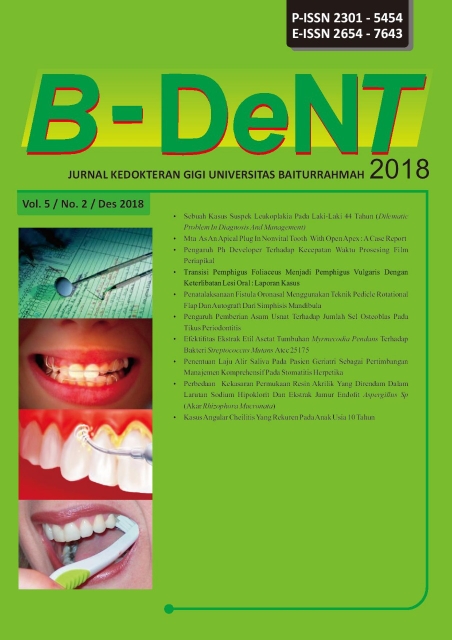
PENENTUAN LAJU ALIR SALIVA PADA PASIEN GERIATRI SEBAGAI PERTIMBANGAN MANAJEMEN KOMPREHENSIF PADA STOMATITIS HERPETIKA
DOI:
https://doi.org/10.33854/jbd.v5i2.163Keywords:
Geriatri, Stomatitis herpetika, Laju SalivaAbstract
Latar belakang Laju saliva adalah sekresi saliva yang dinyatakan dalam ml/menit. Pada pasien geriatri dengan riwayat hipertensi dapat menurunkan kuantitas, kualitas dan laju saliva. Kondisi ini dapat meningkatkan terjadinya infeksi rongga mulut seperti stomatitis herpetika.Tujuan Mengukur laju saliva pada pasien geriatri dengan riwayat hipertensi yang didiagnosa stomatitis herpetika, keilitis eksfoliatif dan hiposalivasi sebagai pertimbangan perawatan yang komprehensif. Laporan kasus Seorang wanita usia 63 tahun datang ke klinik karena sariawan selama beberapa tahun dan mengganggu sejak 2 bulan yang lalu. Pemeriksaan ekstraoral berupa bibir kering. Pemeriksaan intraoral menunjukkan oral hygiene buruk, kondisi mukosa oral yang kering dan terdapat ulser multipel. Pemeriksaan laboratorium menunjukkan eosinofil dan monosit di bawah normal, dan IgG anti HSV-1 reaktif. Laju saliva 0,2 ml/menit, dilakukan dengan metode spitting untuk menegakkan diagnosa hiposalivasi. Penatalaksanaan kasus Pasien diberikan vitamin B12, asam folat untuk meningkatkan daya tahan tubuh, Vaseline album untuk melembabkan bibir, chlorhexidine gluconate 0,2%, oral hygiene instruction dan scalling dilakukan untuk memperbaiki oral hygiene serta disarankan nutrisi seimbang dan hidrasi yang memadai sebagai terapi nonfarmakologi. Diskusi Pasien ini memiliki kondisi yang kompleks: geriatri, oral hygiene yang buruk, menggunakan obat antihipertensi, dan juga mengalami stres emosional. Hal ini dapat menyebabkan penurunan kuantitas dan kualitas saliva sebagai pertahanan mukosa mulut. sehingga pasien akan lebih rentan terhadap infeksi HSV-1 dan reaktivasi. Simpulan Laju saliva dapat menjadi pertimbangan dalam tatalaksana stomatitis herpetika pada pasien geriatri dengan hipertensi dan pengobatan anti hipertensinya.References
Wiener RC, Bei W, Crout R, et al. Hyposalivation and xerostomia in dentate older adults.J Am Dent Assoc 2010 Mar; 141(3): 279–284.
Sven N, Veas L, Barrera C, et al. Risk factors, hyposalivation and impact of xerostomia on oral health-related quality of life. J Braz Oral Res 2016 Dec 6; 31: e14.
Freeman ML, Sheridan BS, Bonneau RH, et al. Psychological stress compromises CD8+ T cell control of latent herpes simplex virus type 1 infections. J Immunol 2007; 179(1): 322–328.
Glick Michael.Burket’s Oral Medicine. Twelfth edition:People’s Medical Publishing House 2015; 219-224.
Gupta A, Epstein JB, Sroussi H.Hyposalivation in elderly patients. J Can Dent Assoc 2006 Nov; 72(9):841–846
Gasperin D, Netuveli G, Costa JS, Pattussi MP. Effect of psychological stress on bloodpressure increase: a meta-analysisof cohort studies. Cad. Saúde Pública 2009; 25(4): 715-726.
Dietz JD, Du S, Bolten CW, et al. A number of marketed dihydropyridine calcium channel blockers have mineralocorticoid receptor antagonist activity.JHypertensionaha 2008; 51: 742-748.
Nonzee V, Manopatanakul S, Khovidhunkit SP. Xerostomia,hyposalivation and oral microbiota in patients using antihypertensive medications. J Med Assoc Thai 2012; 95(1):96-104
Lionakis N, Mendrinos D, Sanidas E, et al.Hypertension in the elderly.World J Cardiol2012 May 26; 4(5): 135-147.
Challacombe S.The Challacombe Scale of clinical oral dryness.King’s College London 2011; 17(1): 109–114.
Glaser R and Kiecolt JK. Stress-induced immune dysfunction:implications for health. NatureReviews 2005 Mar; 5: 243-251.
Carmen Llena Puy. The rôle of saliva in maintaining oral health and as an aid to diagnosis. Med Oral Patol Oral Cir Bucal 2006;11:449-455.
Bain BJ. Hematologi: A core Curriculum. EGC 2014; 18-57.
Marketon JW, Glaser R. Stress hormones and immune function. Elsevier Inc 2008 Feb 14; 16-26.
Kumar SB. Chlorhexidine moutwash-a review. J of Pharm Sci and Res 2017; 9(9): 1450-2.
Downloads
Published
How to Cite
Issue
Section
License
Copyright (c) 2019 Mega Rafika, Indah Suasani Wahyuni, Wahyu Hidayat

This work is licensed under a Creative Commons Attribution-NonCommercial-ShareAlike 4.0 International License.
Authors who publish with this journal agree to the following terms: Authors retain copyright and grant the journal right of first publication with the work simultaneously licensed under a Creative Commons Attribution License (CC BY-NC-SA 4.0) that allows others to share the work with an acknowledgement of the work's authorship and initial publication in this journal.