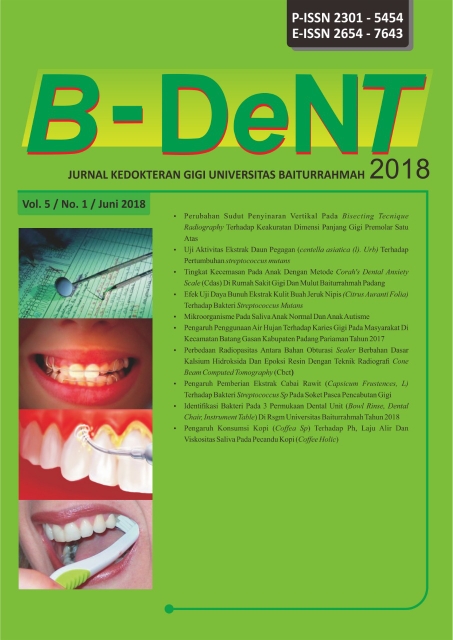
MIKROORGANISME PADA SALIVA ANAK NORMAL DAN ANAK AUTISME
DOI:
https://doi.org/10.33854/JBDjbd.136Keywords:
Autisme, Mikroorganisme, SalivaAbstract
Pendahuluan: Autisme merupakan suatu gangguan perkembangan yang mempengaruhi fungsi normal otak, perkembangan interaksi sosial dan kemampuan berkomunikasi. Anak autisme memiliki kepedulian yang rendah terhadao diri sendiri, sensitif terhadap bulu sikat dan pasta gigi, cenderung mengkonsumsi makanan kariogenik, dan memiliki kelainan motorik lidah. Keterbatasan yang dimiliki anak autisme tersebut menyebabkan anak autisme lebih berisiko terhadap penyakit periodontal dan karies gigi. Karies merupakan penyakit jaringan keras gigi akibat aktivitas mikroorganisme dalam suatu karbohidrat yang dapat diragikan dan penyakit periodontal adalah penyakit pada jaringan pendukung gigi yang faktor penyebab utamanya adalah mikroorganisme, kedua penyakit tersebut erat kaitan terjadinya dengan kondisi rongga mulut salah satunya adalah saliva. Tujuan penelitian ini adalah untuk mengetahui perbedaan jenis dan jumlah koloni mikroorganisme pada saliva anak autisme dan anak normal yang mengalami karies. Metode: Penelitian ini menggunakan pendekatan cross sectional, subjek penelitian anak autisme yang berada di SLB Autisma YPPA Kota Padang dan anak normal yang berada di SD N 05 Sawahan Kota Padang. Sampel penelitian berupa saliva dilakukan pembiakkan mikroorganisme pada media agar darah. Data dianalisis menggunakan uji Mann-Whitney. Hasil: Terdapat perbedaan jenis mikroorganisme pada saliva anak normal dan anak autisme. jenisMikroorganisme pada saliva anak autisme yaitu Streptococcus sp, Neisseria sp, Staphylococcus aureus, dan Candida sp, sementara pada saliva anak normal jenis Streptococcus sp dan Neisseria sp. Hasil uji statistik perbedaan jumlah Streptococcus sp didapatkan nilai p=0,001, pada Neisseria sp didapatkan nilai p=0,012. Kesimpulan: Terdapat perbedaan jenis dan jumlah koloni mikroorganisme pada saliva anak normal dan anak autisme.References
Tulangow, Gita J. Damajanty H C Pangamenan. Wulan G Parengkuan. 2015. “Gambaran Status Karies pada Anak Berkebutuhan Khusus di SLB YPAC Manado”. Jurnal e-GiGi. Volume 3. Nomor 2. Juli-Desember.
Balitbang, Kemenkes RI. 2013. Riset Kesehatan Dasar; RISKESDAS. Jakarta: Balitbang Kemenkes RI.
Rizkika, Nabila. Moh Baehaqi. R Rama Putranto. 2014. “Efektivitas Menyikat Gigi Dengan Metode Bass dan Horizontal Terhadap Perubahan Indkes Plak pada Anak Tunagrahita”. ODONTO Dental Journal. Volume 1. Nomor 1. Mei.
Sengkey, Monica M. Damajnty H C Pangemanan. Christy N Mintjelungan. 2015. “Status Kebersihan Gigi dan Mulut pada Anak Autis di Kota Manado”. Jurnal e-GiGi. Volume 3. Nomor 2. Juli-Desember.
Motto, Christavia J. Christy N Mintjelungan. Shane H R Ticoalu. 2017. “Gambaran Kebersihan Gigi dan Mulut pada Siswa Berkebutuhan Khusus di SLB YPAC Manado”. Jurnal e-GiGi. Volume 5. Nomor 1. Januari-Juni.
Anggraini, Laelia Dwi. 2007. “Kesehatan Gigi Anak Autis”. Mutiara Medika. Volume 7. Nomor 2. Hal 104-108. Juli.
Diab, Hafez M. Suha Saeed Motlaq. Amal Alsharare dkk. 2016.
“Comparison of Gingival Health and Salivary Parameters among Autistic and Non-Autistic School Children in Riyadh”. Journal of Clinical and Diagnostic Research. Volume 10. Nomor 10. Oktober.
Orrelana, R. Fransisco JS. Sonia M. dkk. 2012. “Oral Manifestations in a Group of Adults with Autism Spectrum Disorder”. Volume 1. Nomor 17
Delli,Konstantina. Peter A. Reichart.Michael M. Bornstein. Dkk. 2013. “Management of children with Autism Spectrum Disorder in the Dental Setting: Concerns, Behavioural Approaches and Recommendations”. Journal Section Medical Compromised Patiens in Dentistry. Volume 18. Nomor 6.
Azzahra, N. Siti W. Didit A. 2014. “Indeks Kebersihan Rongga Mulut pada Anak Retardasi Mental”. Dentino Jurnal Kedokteran Gigi. Volume 11. Nomor 1
Silva, Da SN. Gimenez T. Souza RC. dkk. 2016. “Oral Health Status of Children and Young Adults with Autism Spectrum Disorders: Systemic Reviewand Metaanalysis”. International Journal Pediatric Dentistry.
Chadha, Gagandeep Mohinderpal. Pradnya Kakodkar. Vishwas Chaugule. 2012. “Dental Survey of Institutionalized Children with Autistic Disorder”. International Journal of Clinical Pediatric Dentistry. Volume 5. Nomor 1. Hal. 29-32. Januari-April.
Prasetya, Rendra Chriestedy. 2008. “Perbandingan Jumlah Koloni Bakteri Saliva pada Anak-anak Karies dan Non-karies Setelah Mengkonsumsi Minuman Berkarbonasi”. Indonesian Journal of Dentistry. Volume 15. Nomor 1. Hal 65-70.
Guo, Lihong. Wenyuan Shi. 2013. “Salivary Biomarkers for Caries Risk Assesment”. J Calif Dent Assoc. Volume 41. Nomor 2. Hal. 107-118. Februari.
Singh, Shikha. Arun Sharma. P B Sood dkk. 2015. “Saliva as a Prediction Tool for Dental Caries: An In Vivo Study”. Journal of Oral Biology and Craniofacial Research. Hal. 59-64.
Qiao, Yanan. Mingtao Wu. Yanhuizhi F. dkk. 2018. “Alterations of Oral Microbiota Distinguish Children with Autism Spectrum Disorders from Healthy Controls”. Scientific Reports. Volume 8. Nomor 1597.
Adams, James B. Leah J J. Linda D P. 2011. “Gastrointestinal Flora and Gastrointestinal Status in Children with Autism-comparisons to Typical Children and Correlation with Autism Severity”. BMC Gastroenterology. Volume 11. Nomor 12.
Gondalia, S. Enzo A. Simon R. dkk. 2010. “Faecal Microbiota of Individuals with Autism Spectrum Disorder”. Electronical Journal of Applied Psychology. Volume 6. Nomor 2. Hal. 24-29.
Arieas, Cristina. Benedita S. Maria De L. dkk. 2012. “Reduced Salivary Flow and Colonization by Mutans Streptococci in Children with Down Syndrome”. CLINICS. Volume 67. Nomor 9.
Oda, Yuki. Fumiko Hayashi. Atsuko Wakita. dkk. 2017. “ Five Year Longitudinal Study of Dental Caries Risk Associated with Streptococcusmutan sand Streptococcussobrinusin Individuals with Intellectual Disabilities”. Journal of Oral Science. Volume 59. Nomor 1. Hal 39-46.
Keller, Mette K. Christine A. Daniel B. dkk. 2017. “Oral Microbial Profile of Individuals with Different Levels of Sugar Intake”. Journal of Oral Microbiology. Volume 9.
Scalioni, Flavia. Camila C. Fernanda M. dkk. 2017. “Salivary Density of Streptococcus mutans and Streptococcus sobrinus and Dental Caries in Children and Adolescents with Down Syndrome”. Journal of Applied Oral Science. Volume 25. Nomor 3.
Emam, AM. Mamdouh M. Abdelrahim A. 2012. “Candida albicans Infection in Autism”. Journal of American Science. Volume 8. Nomor 12.
Downloads
Published
Issue
Section
License
Copyright (c) 2019 Nadhifah Salsabila, Valendriyani Ningrum, Leny Sang Surya

This work is licensed under a Creative Commons Attribution-NonCommercial-ShareAlike 4.0 International License.
Authors who publish with this journal agree to the following terms: Authors retain copyright and grant the journal right of first publication with the work simultaneously licensed under a Creative Commons Attribution License (CC BY-NC-SA 4.0) that allows others to share the work with an acknowledgement of the work's authorship and initial publication in this journal.