
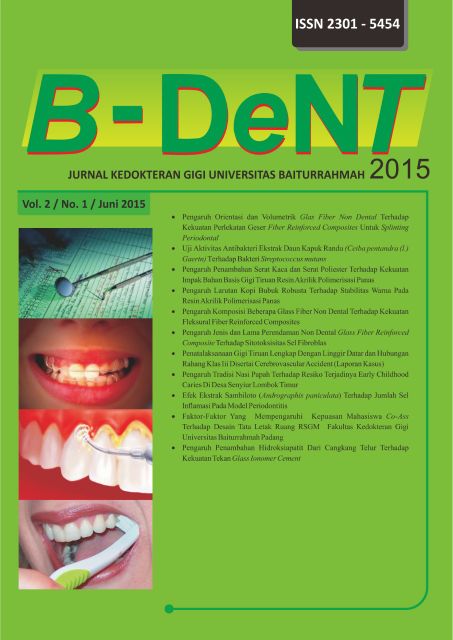
PENGARUH KOMPOSISI BEBERAPA GLASS FIBER NON DENTAL TERHADAP KEKUATAN FLEKSURAL FIBER REINFORCED COMPOSITES
DOI:
https://doi.org/10.33854/JBDjbd.12Keywords:
Glass Fiber Non Dental, Orientasi Fiber, Volumetrik Fiber, Kekuatan Perlekatan Geser, Splinting PeriodontalAbstract
E-glass fiber merupakan fiber reinforcement yang sering digunakan di kedokteran gigi karena berikatan baik dengan polimer melalui silane coupling agent, meningkatkan kekuatan mekanis dan tidak sensitif terhadap kelembaban. Ketersediaan E-glass fiber dental di Indonesia terbatas dengan harga relatif mahal. Glass fiber non dental banyak tersedia di Indonesia dengan harga terjangkau, yang biasa digunakan pada pembuatan panel gypsum dan komponen otomotif. Tujuan penelitian ini adalah mengetahui pengaruh komposisi glass fiber non dental terhadap kekuatan fleksural fiber reinforced composites. Bahan yang digunakan dalam penelitian ini adalah E-glass fiber dental (Fiber-splint, Polydentia SA, Switzerland), glass fiber non dental A (LT, China), B (CMAX, China) dan C (HJ, China), flowable composite (CharmFil Flow, Denkist, Korea) dan silane coupling agent (Monobond S, Ivoclar Vivadent, Liechtenstein). Subjek dibagi dalam 5 kelompok: tanpa fiber, E-glass fiber dental, glass fiber non dental A, B dan C . Uji kekuatan fleksural berdasarkan ISO 10477. Hasil yang diperoleh dianalisis menggunakan ANAVA satu jalur. Hasil penelitian menunjukkan rerata kekuatan fleksural (MPa) terendah pada kelompok tanpa fiber (126,18±5,21) dan tertinggi pada kelompok glass fiber non dental A (208,03±8,32). Hasil ANAVA satu jalur menunjukkan pengaruh bermakna dari komposisi fiber terhadap kekuatan fleksural (α < 0,05). Kesimpulan penelitian: Kandungan SiO2, Al2O3 dan alkali tanah oksida (MgO dan CaO) yang tinggi pada glass fiber meningkatkan kekuatan fleksural dari fiber reinforced composites.References
Rodan, R., Al-Jabrah, O., dan Ajarmah, M., 2012, Adverse Effects of Removable Partial Dentures on Periodontal Status and Oral Health of Partially Edentulous Patients. Journal of The Royal Medical Services. 19(3) : 54-58.
Sadaf, A., Yazdanie, N., dan Ibrahim, A., 2012, Evaluation of Oral Function after Removable Partial Denture Therapy. Pakistan Oral & Dental Journal. 32(3) : 561-563.
Chafaie, A., dan Portier, R., 2004, Anterior Fiber-Reinforced Composite Resin Bridge : A Case Report. Pediatric Dentistry. 26(6) : 530-534.
Piovesan E.M., Demarco F.F., dan Piva E., 2006, Fiber-Reinforced Fixed Partial Dentures : A Preliminary Retrospective Clinical Study. J. App Oral Sci. 14(2) : 100-4.
Cenci, M.S., Rodolpho, P.A., Pereira-Cenci, T., Del Bel Cury, A.A., dan Demarco, F.F., 2010, Fixed Partial Dentures in an Up to 8-Year Follow Up. J.App. Oral Sci. 18(4) : 364-71.
Sinkiewicz, D., 2013, Bridging The Gap Between Porcelain and Fibre-Reinforced Composite Bridges. Dental Tribune. 16-18.
Alla, R.K., Sajjan, S., Alluri, V.R., Ginjupalli, K., dan Upadhya, N., 2013, Influence of Fiber Reinforcement on The Properties of Denture Base Resins. J of Biomat and Nanobiotech. 4 : 91-97.
Raszewski, Z., dan Nowakowska, D., 2013, Mechanical Properties of Hot Curing Acrylic Resin after Reinforced with Different Kinds Of Fibers. Int. J. of Biomed. Mat Research. 1(1) : 9-13.
Zhang, M., dan Matinlinna, J.P., 2012, EGlass Fiber Reinforced Composites in Dental Applications. Silicon. 1-5.
Stromberg., 2012, Glass Fiber Reinforced Gypsum. http://www.strombergarchitectural.com/materials/gfrg. diunduh 16 April 2015.
Johnson, T., 2015, Uses of Fiberglass. http://composite.about.com/od/aboutglass/a/Uses-Of-Fiberglass.htm. diunduh 16 April 2015.
Sari, W.P., Sumantri, D., Imam, D. N. A., dan Sunarintyas, S., 2014, Pemeriksaan Komposisi Glass Fiber Komersial dengan Teknik X-Ray Fluoresence Spectrometer (XRF). J. B-Dent. Vol 1 (2) : 151-160.
Junior, A.A., Lopes, M,W., Gaspar, G.S., dan Braz, R., 2009, Comparative Study of Flexural Strength and Elasticity Modulus in Two Types of Direct Fiber-Reinforced Systems. Braz. Oral Res. 23(3) : 236-40.
Juloski, J., Beloica, M., Goracci, C., Chieffi, N., Giovannetti, A., Vichi, A., Vulicevic, Z.R., dan Ferrari, M., 2012, Shear Bond Strength to Enamel and Flexural Strength of Different Fiber-Reinforced Composites. J.Adhes. Dent. 14(10) : 1-8.
Li, H., Meng, J., dan Richards, C.A., 2012, Alkaline Earth Aluminosilicate Glass : Route to High Modulus Fiber Reinforced Composites. Int. Fiber Glass Symposia. 1-7.
ISO 10477., 2004, Dentistry – Polymer-Based Crown and Bridge Materials. 2nd ed. International Organization for Standarization, Geneva, Switzerland
Fonseca, R.B., Favarao, I.N., Kasuya, A.V.B., Abrao, M., Luz, N.F.M., dan Naves, L.Z., 2014, Influence of Glass Fiber Wt% And Silanization on Mechanical Flexural Strength of Reinforced Acrylics. J. of MaT.Sci and Chem. Eng. 2 ; 11-15.
Duymus, Z. Y., Karaalioglu, F. O., Suleyman, F., 2014, Flexural Strength of Provisional Crown and Fixed Partial Denture Resins both with and without Reinforced Fiber. J of Mat. Sci. and Nanotech. 1(3) : 1-4.
Wang, R., Zheng, S., dan Zheng, G,, 2011, Polymer Matrix Composites and Technology. Elsevier : St.Louis, Missouri. 33-44.
Loncar, A., Vojvodic, D., jerolimov, V., Komar, D., dan Zabarovic, D., 2008, Fiber Reinforced Polymers Part II: Effect on Mechanical Properties. Acta Stomatologica Croatica. 42(1) : 49-63.
AGC., 2014, All about Glass, http://www.yourglass.com/agc-glasseurope/gb/en/toolbox/pocket/2/All-aboutglass.pdf .diunduh tanggal 9 November 2014.
Zhang, Y., Cao, G., Zhang, B., Zhang, L., Xing, W., dan Gu, G., 2010, Glass Fiber Composition. Paten CA 2745050 A1. 1-6
Kogel, J.E., Trivedi, N., Barker, J.M., dan Krukowski, S.T., 2006, Industrial Minerals & Rock-Commodities, Markets and Uses. 7thed. Society for minimg, metallurgy and exploration Inc. 1369-1374.
Mallick, P.K., 2008, Fiber Reinforced Composites. Materials, Manufacturing and Desain. 3th ed CRC Press : Franc.
Rapp, C. F., dan Mattson, S. M., 2001, Glass Fiber Composition. Paten EP 1027298 A4. 1-6.
Goroushi, S.K., Lassila, L.V.J., dan Vallittu, P.K., 2000, Short Fiber Reinforced Composite: The Effect of Fiber Length and Volume Fraction. The J Contemporary Dent. Pract. 7(5) : 1-10.
Downloads
Published
How to Cite
Issue
Section
License
Copyright (c) 2018 Widya Puspita Sari, Siti Sunarintyas, Nuryono Nuryono

This work is licensed under a Creative Commons Attribution-NonCommercial-ShareAlike 4.0 International License.
Authors who publish with this journal agree to the following terms: Authors retain copyright and grant the journal right of first publication with the work simultaneously licensed under a Creative Commons Attribution License (CC BY-NC-SA 4.0) that allows others to share the work with an acknowledgement of the work's authorship and initial publication in this journal.